

A legal claim which almost 4,000 people have joined, challenging river pollution in the Wye and Usk catchment areas, has been filed at the High Court.
The court action is against industrial chicken production firms, Avara Foods Limited and Freemans of Newent Limited as well as sewage company Welsh Water, Dwr Cymru Cyfyngedig, who are blamed for extensive and widespread pollution in the rivers Wye and Lugg and their tributaries. Welsh Water is blamed for pollution in the river Usk.
The three companies have denied the claims to law firm Leigh Day which represents the claimants.
Now the claims have been served on the defendants and the Particulars of Claim are with the High Court. Avara, Freemans and Welsh Water must file a defence and, unless the claim is settled, it will be heard in a civil trial at the High Court. The defendants also have the right to apply for the claims to be struck out.

The 3,943 people who have signed up to be claimants are all residents, local business owners, or people who use the rivers Wye, Usk and Lugg for leisure and family time. They include people with riverside properties or fishing rights and other householders or tenants who live or run businesses near to intensive poultry units, chicken growing farms or sewerage infrastructure. Businesses who rely on local tourism and river activities have also joined the claim.
All allege that Avara, Freemans and Welsh Water are responsible for river pollution and the severe impact it has had on businesses, recreation, tourism and property values since August 2019 and ask the court to award substantial damages for that period. They also ask the court to order all three companies to clean up the rivers and restore them to health.
A key section of the claim is brought on behalf of people impacted by the Lugg Moratorium – a building ban in force around the river Lugg since 2019 in an attempt by Herefordshire County Council to protect the river from further pollution. It is estimated that the moratorium has cost individual claimants tens of thousands of pounds in the period since 2019 in planning fees and financial losses.
The claim against Avara, Freemans and Welsh Water alleges that pollution has been caused by water run-off from farm land containing high concentrations of phosphorus, nitrogen and bacteria resulting from the spreading of thousands of tonnes of poultry manure and sewage bio solids. It also alleges bacteria and nutrient pollution has been caused by the discharge of sewage directly into the rivers from Welsh Water sewerage systems.
High concentrations of phosphorus and nitrogen in the river have caused substantial growth of algae which cuts oxygen, suffocating fish and harming fauna, leading to key species deaths, as well as reduced growth and bad smells as it decays.
The claim alleges the pollution has caused private nuisance, public nuisance and trespass (from sewage deposited on the river bed) as well as negligence, and that the deposit of manure and bio solids on agricultural land is a breach of section 73(6) of the Environmental Protection Act.
The legal claim calls for damages for the impact on local properties of odours, insects and noise nuisance at 101 industrial chicken growing farms at least, as well as sewage pumps and treatment plants.
The claim is led by Leigh Day international and group claims partner Oliver Holland, who said: “We see this legal claim as the culmination of an extraordinary effort by local community members and campaign groups to research, monitor and advocate for their rivers. The claimants have watched their rivers become the subject of national press coverage, public campaigns, Parliamentary debates and government pledges. Formally commencing this legal action is a concrete step towards protecting these vital national ecosystems.
“The court will now hear leading experts on the allegations of environmental harm, and will be asked to order those responsible to clean up these rivers, and restore these communities and wildlife that depend on them.
“This is the largest legal action concerning environmental pollution ever brought in the UK. In a context where government and regulators have failed to prevent the degradation of our rivers the court has become the last avenue for justice. Our clients believe they have no other option but to seek accountability through the legal system – and this marks the next step in that journey.”
Oliver Holland’s legal team also includes solicitors Celine O’Donovan and Benji Gourgey.
The team have instructed Anneliese Day KC at Fountain Court Chambers, Russell Hopkins at Temple Garden Chambers, Catherine Dobson at Matrix Chambers, Nicholas Ostrowski at Six Pump Court and Alistair MacKenzie at 2 Temple Gardens.
The defendants were served with the claim as of Monday, September 15 2025. The pleadings were filed with the High Court on Friday, September 192025.
A Welsh Water spokesperson said:“Welsh Water is a not-for-profit company, unlike other water companies. The amount we can charge for our services is subject to regulatory control, which therefore limits the funds available to us for re-investing into our infrastructure. Despite these financial constraints, we have made significant investments over recent years, and we have achieved real improvements in water quality.
“In the past five years we have delivered £70 million of investment to improve our sites on the Wye River – and delivered them ahead of the target set by our regulators. We are also currently investing £33 million to improve the Usk River. Unfortunately, the water pollution caused by other sectors during this period has increased significantly, reducing the overall impact of the water quality improvements we have achieved.
“We intend to defend this case robustly: the fact that we are a not-for-profit company means that any payments to these claimants would necessarily reduce the amount that we can re-invest in delivering further improvements for the benefit of all of our customers and the environment.”
A spokesperson for Avara Foods said: “We share concerns about the condition of the River Wye, but we believe that this legal claim is based on a misunderstanding, as no manure is stored or spread on poultry-only farms that supply Avara Foods. Where poultry manure is used as fertiliser, it is for other produce in other agricultural sectors. Individual farmers are responsible for how nutrients are used in their arable operations.
“Avara is not involved in any arable operations and has no control over this activity. All our poultry is produced in Britain to standards that are amongst the highest in the world. The focus instead needs to be on solutions that will improve the health of the river, addressing all forms of pollution and the effects of climate change, and for action to be taken accordingly. We employ 5,000 people in the UK and approximately 1,500 people in the catchment area, and we all want a healthy River Wye."
Film maker is lead claimant
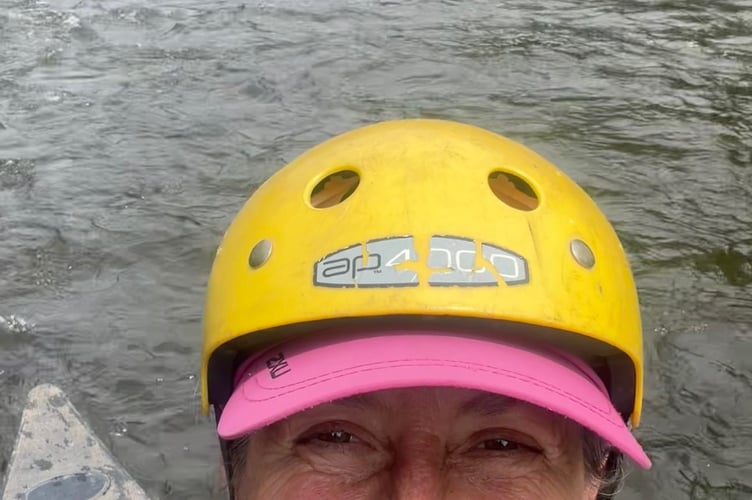
Justine Evans is acting as the lead claimant in the case. She works in wildlife film making for international broadcasters and moved to the Wye area in 2012.
Justine recalls that the River Wye used to be clear, with the natural growth of plants and wildlife on and beneath its surface easily visible. But in recent years, she has seen a stark decline in its condition.
Around the time of the Covid pandemic, Justine observed a large algal bloom which gave the river a pea soup appearance. She says the condition has continued to worsen in the years since, leaving it in a murky and slimy state.
Having previously enjoyed activities such as swimming and canoeing in the Wye, Justine now feels more cautious about direct contact with the water and, like many people she knows, would not want to put her head under the water.
As a result, Justine now spends far less time around the river. She is concerned about the possible health effects of swimming in the Wye, and feels the connection between the community and the river has been damaged.
Justine Evans said: “The River Wye is a beautiful place that so many people get enjoyment from. It offers a special, natural relationship between people and the environment. This connection is something that should be nurtured, but instead it is being shattered by the worsening state of the river.
“My relationship with the river has completely changed in recent years, to the point I no longer feel comfortable going in it. It’s horrible to think what has happened to the wildlife it is home to. Kids are growing up seeing the river now as it is now thinking this is its normal state, but it’s just not what rivers should look like.
“I now have to cast my mind far back to try and think ‘what did the river used to be like?’. The feeling of contentment I used to get from being in the river has all but disappeared.”
Comments
This article has no comments yet. Be the first to leave a comment.