
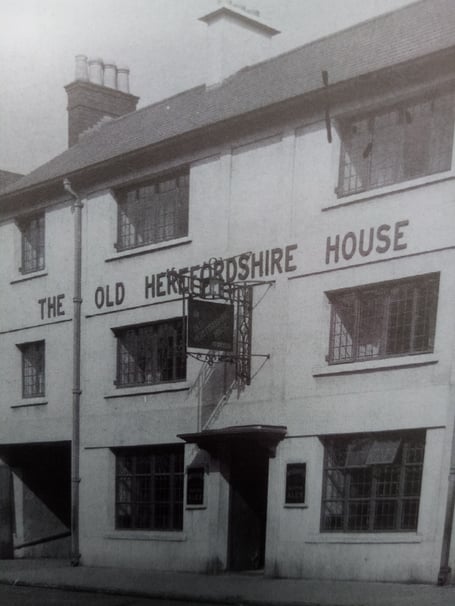
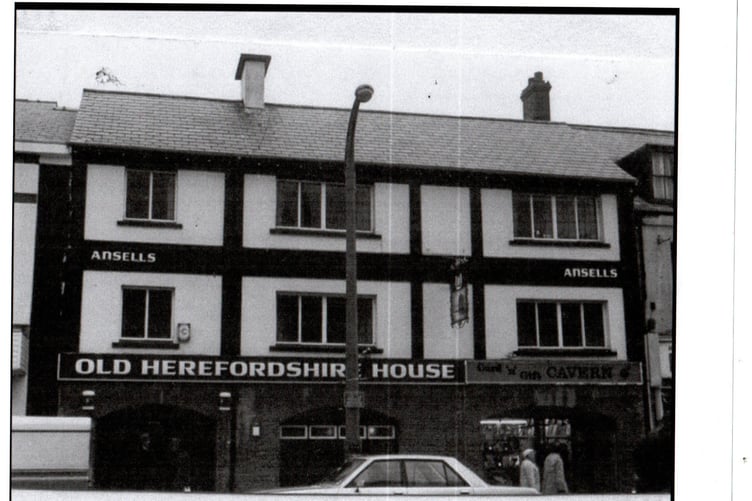
TEN years prior to the notorious Abergavenny pub riots the publican of the Old Herefordshire House was Thomas Pritchard and he is shown on the 1871 census as being 37 years of age with a 33-year-old wife, Emma, and a six-year-old daughter Martha.
The following year, 1872, Thomas died of smallpox leaving his wife, Emma, to run the pub. Sometime afterwards Emma met David Roger Jones and he moved in with her. (This was the Jones who became known as “Dr” Jones, because his initials “D. R.” were inscribed close together on the front of the building.)
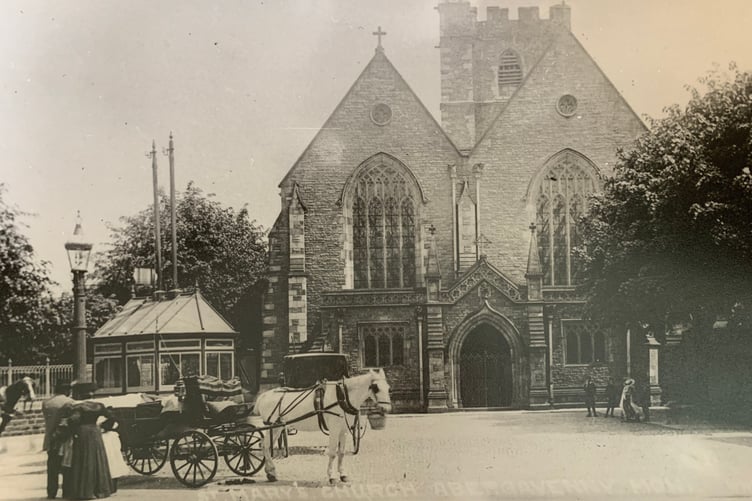
On the 11th of June 1873 D. R. Jones and Emma were married in St. Mary’s Church, Abergavenny.
.jpeg?width=209&height=140&crop=209:145,smart&quality=75)
Over the next few years, Emma turned to drink and died at the age of 44 in January 1881. The death certificate records the cause of death as alcoholism. The next census, April 1881, now records David R. Jones, widower, aged 38 as a publican and licensed victualler of the Old Herefordshire House and his 16-year-old step-daughter, Martha, is recorded as a barmaid.
David Jones also has a 5-year-old son from his marriage to Emma.
Emma’s will, dated 5th of July 1875, implies that her first husband had left the pub to her and she now left the pub to her daughter, Martha, on condition that she allows Mr. Jones use of the pub until she: “shall attain the age of 21 years or the said Mr. Jones shall die whichever shall first happen.” (This appears to be contrary to the existing practice that all a wife’s property belonged to her husband and only changed with the introduction of the Married Woman’s Property Act of 1882.)
Perhaps this legal dilemma was the reason that David Roger Jones decided to marry his step-daughter, Martha Pritchard, by licence, on the 9th of July 1881 at Newport.
The church record shows that the given ages of the bride and groom were slightly exaggerated! Her age had gone up from 16 to 21 and his age had dropped from 38 to 36.
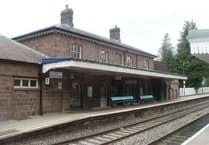
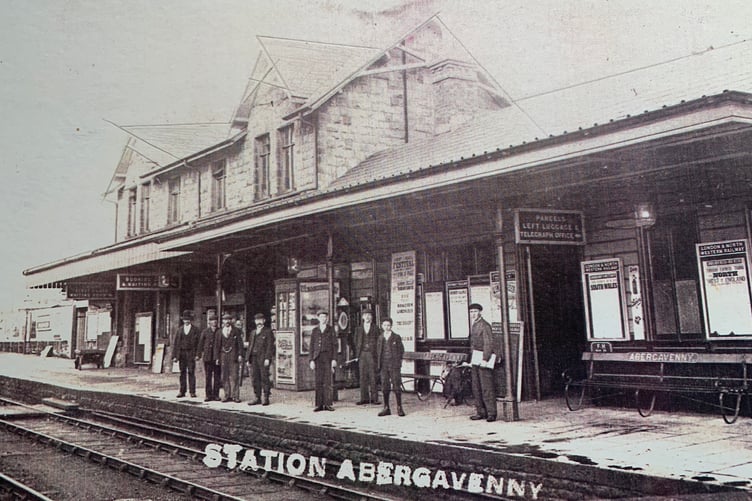
Rumours had been circulating that David Roger Jones of the Old Herefordshire House was about to marry his step-daughter but it was soon being said that the marriage had already taken place and the bride and groom were returning home via the Brecon Road Railway station.
A large crowd assembled there but discovered that the couple were not on the train.
The crowd then moved on to the Old Herefordshire House where they made a lot of noise to vent their disapproval of the marriage.
There was no sign of life in the building and so the crowd dispersed only to return the following night to make much more noise. No reaction came from anyone who may have been inside and so the crowd became more active and stones were thrown through the windows.
They then charged the door to try and force entry but the watching policemen then moved forward to stop a forcible entry and this resulted in a free-for-all melee. Windows were kicked in but the police seemed to be taking the matter in a good-humoured way.
One boy was taken into custody for throwing a stone and several names were taken by the policemen. Threats to pull down the house the next night did not mature and it appears that Mr. and Mrs. Jones went away for a time until the excitement had cooled down.
The Chronicle reported that,“What was felt by many people to be an outrage on morality, and a reflection upon a community, had met with public condemnation, and it was no doubt thought by most people that public sentiment had been sufficiently expressed. A mere wanton destruction of property can gain no end, except to saddle the county with the cost of its restoration and to bring discredit upon its perpetrators.”
Court cases followed the incident and one instance was that of a 15-year-old boy, Edward White, who was charged with doing wilful damage to the Herefordshire House.
His defence solicitor said, “That he must admit that the boy threw a stone, but was it not ridiculously absurd that a little fellow like the defendant should be accused of doing wilful damage in a crowd of over a thousand people? The lad saw others throwing and no doubt thought it a spree, and threw a stone which could not have done much damage by hitting the wall of the building. "However, the police had always been valiant in capturing small boys, and on this occasion had kept up their prestige by taking this poor little fellow into custody and locking him up for the night.
"He suffered all the discomfort of a police cell for one whole night – quite sufficient punishment for one so young who had only done what their worships would very likely have done at his age in similar circumstances. I must ask you to consider that the punishment he had already received was sufficient and not inflict a fine on the boy. He should be given a sharp lecture that would also serve as a deterrent to other youths in the town.”
The magistrate replied that he was sorry they couldn’t order the defendant to be flogged. Instead of fining him £5 as they could have done, they would let him off with 2s. 6d. and costs and they hoped it would be a lesson to him in the future.
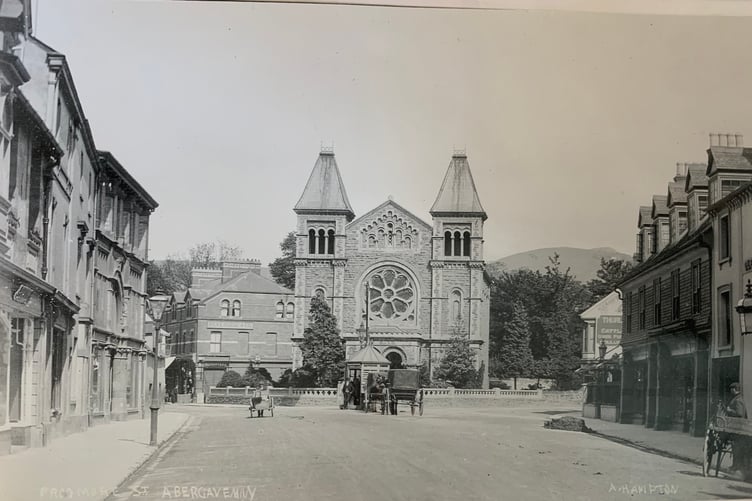
The reporter understood that a defence fund had been started and subscribed to for the purpose of defraying the expense of employing a legal advocate and paying any fines that might be inflicted in the cases connected with the demonstration in Frogmore Street.
By 1884 the relationship between David and Martha had gone sour and Martha took her husband to court on two separate charges: firstly, she wanted a divorce and secondly, she wanted ownership of the pub as her late mother’s will had stipulated.
The divorce was granted to Martha, using her maiden name of Pritchard, without any difficulty.
Regarding the aspect of who was entitled to the property, the contemporary newspapers give different details of the court case. One said that Emma had left the pub to her husband and not her daughter. Martha claimed that her mother was under duress to change the will.
After a short hearing, the judge commented that he thought that this was a matter of spite on behalf of the young woman who had contracted this incestuous marriage with the defendant, David Roger Jones, and found in his favour.
Martha went on to marry John Christopher Lewis in March 1886 at St. Mary’s Church, Abergavenny.
By 1885, David Roger Jones had returned to his home town of Newcastle Emlyn and he retained part ownership of the Old Herefordshire House until his death in 1912.
In 1903 he put his name forward to be elected onto the local urban district council – he classed himself as a ‘gentleman.’
His 18-year-old son, Thomas Watt Jones, caused a sensation in 1906 when he was arrested on a charge of causing the death of an 8-year-old boy by shooting him with a double-barrelled shotgun.
Thomas had been friendly with the boy and they were playing in a passage outside his house where his father kept the gun. Thomas picked up the gun without realising that one barrel was loaded and it was half cocked. The next thing he knew was the gun went off and the boy collapsed in front of him.
Thomas carried the boy into the house and frantically tried to save him but he died shortly afterwards.
The coroner expressed the opinion that keeping weapons, like the Jones family had, was a recipe for disaster and should be a lesson to all. After an inquest and a court case, it was decreed that it had all been a tragic accident and Thomas was free to walk from the court without a stain on his character.
The Abergavenny Chronicle dated the 20th of May 1887 ran the following advert, “The Old Herefordshire House Hotel was up for sale by an auction to take place on the premises. It was described as containing an entrance passage, bar, sitting room, smoke room, a large dining room, market room, kitchen, pantry, wine and beer cellars and W.C. on the ground floor, and on the upper floors, a sitting room and 10 commodious bedrooms. There is a carriage drive to the rear where there are large yards, a brewhouse, washhouse and coalhouse. The stabling comprises seven loose boxes and six stalls. There are also piggeries and a large and most productive kitchen garden. The property is most desirably situated in the main street of the town, within five minutes’ walk of the L. & N. R. railway station and is now let to Messrs. A. Buchan & Co. Ltd. on a repairing lease for 21 years, from 5th of April 1883, at a yearly rent of £65, one moiety of which is payable to Mr. Dd Roger Jones, now aged about 45 years, for and during the term of his natural life.” (A ‘moiety’ is an old legal term meaning half of everything.)
There was no follow-up report on this sale and so we do not know the outcome, but the electoral register for Abergavenny showed that David Roger Jones of Newcastle Emlyn had voting rights with ownership of The Old Herefordshire House as the qualifying property up until the time of his death in 1912.
Comments
This article has no comments yet. Be the first to leave a comment.