

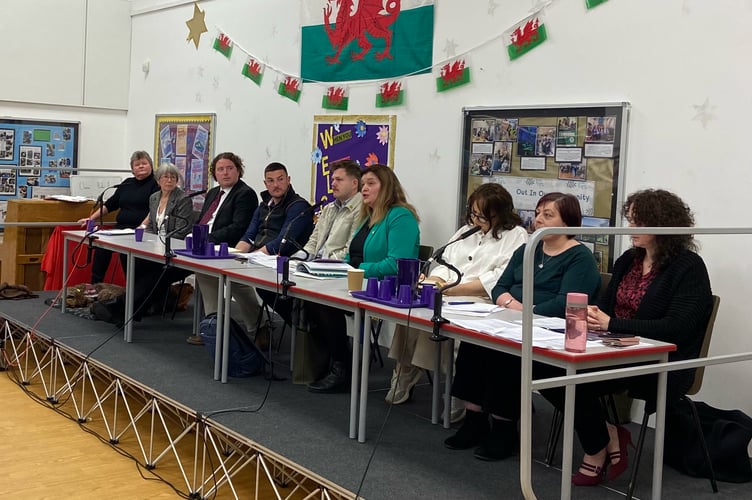
Eight passionate candidates for the Brycheiniog Tawe Nedd constituency faced questions from the public last week at the Senedd Election Hustings in Talgarth.
The event, hosted by Talgarth & District Regeneration Group, Talgarth Community Library and The Friends of Ysgol y Mynydd Du took place at Ysgol y Mynydd Du.
The hustings was chaired by Regional Editor at Tindle Newspapers, Liz Davies. The panel of candidates included outgoing MSs James Evans of Reform UK and Sioned Williams of Plaid Cymru; Cllr Nathan Goldup-John of the Welsh Green Party; Cllr Alex Sims of Welsh Labour; Cllr Jackie Charlton of the Welsh Liberal Democrats; Dr. Liz Hill-O’Shea of the Welsh Conservatives; Jennifer Roberts of the Heritage Party, and independent candidate Cllr Beverley Baynham of Presteigne.
Each candidate was given two minutes to introduce themselves to the packed school hall and were given one minute each to answer questions submitted by the public. Following the questions, they were each given two minutes for a closing speech.

FULL TRANSCRIPT:
Question 1: “Please can the candidates tell us which of their party’s policies they are most proud of at a local and national level?”
Alex Sims (Welsh Labour): “I think on a national level one of the things I am most proud of over the last five years is the introduction of the 21st Century Schools programme which has really helped in conjunction with local authorities develop and build new schools that are fit for this century of learning and setting up children for the future.
“On a local level, and I’m going to try and avoid any dart from Welsh Labour when I say this but it doesn’t really matter what local authority we are talking about, I think one of the proudest policies I have seen from any local authority is how they have all managed to try and keep as many services as they possibly could have done during times of austerity and protect their local populations as much as they could without having to cut services back and leave people stranded.”
Jackie Charlton (Welsh Liberal Democrats): “The two policies that I want to pull out from the Welsh Liberal Democrats is the one you would expect me to say and that is social care and we know that the Welsh Liberal Democrats really care about social care on a UK national level as well as in Wales. In the budget settlement recently in the Senedd, Jane Dodds recently got an extra £30 million that we then shared out amongst local authorities to do certain things with social care. In Powys what it has done is pull people back from the hospitals back into their local communities and their homes and that’s something I’m really proud of and have witnessed firsthand.
“The second policy, which I think is really pertinent here, is cleaning up our rivers and we know that Jane (Dodds) has been very passionate about work she has done with the Wye and the Usk and that is another £30 million she got in the budget settlement. We know we are committed to that and the new strategy coming out which is ‘Shape our rivers for the future in Wales’ is a massive policy which Jane has had a massive contribution in, as I have to.”
James Evans (Reform UK): “I suppose the policy I’m most proud of is one I pushed through myself actually with the mental health bill for Wales. It was a bill that was supposed to improve mental health impacts for children here in Wales. It’s something that I worked very closely with the current Welsh government during my time in the Senedd to make sure young people could get reassessments, making sure that they were put at the heart of decision making when mental health decisions were made about them. The bill didn’t progress to a final bill but I was able to get that embedded in the new mental health strategy, something that I was very proud of, which is improving the lives of young people across Wales and managed to get some additional money allocated to that through the mental health minister. I was very proud of doing that for people locally, but not just here, people across Wales as well.
“On a national policy, we are a new party so we have not been in government or have a large group in the Senedd yet but I’m sure if we are in government, the best is yet to come.”
Nathan Goldup-John (Welsh Green Party): “I’d say scrapping council tax is one of the most regressive unfairest taxes that we have in Wales and the UK and we would replace that with the land value tax which would be much fairer.
“And secondly, nationalising Dwr Cymru. Forty percent of the bill that everyone pays in this room goes to servicing their debt. That is just absolutely unacceptable, so nationalising them and making sure they actually end the pollution in the rivers. We will enforce rules from National Resources Wales to make sure our rivers are cleaned up.”
Sioned Williams (Plaid Cymru): “For the past five years I’ve been Plaid Cymru’s spokesperson for social justice. I think the policy I am most proud of is the introduction of universal free school meals for primary school children. This is something that the Welsh Labour Government weren’t going to implement and indeed voted against time and time again in the Senedd when we brought a motion spelling out the international evidence that we had that this could make a difference to children, and their families and the cost of living. It is one of our big achievements that we managed to get that through, and I led on that policy in the last five years and I’m really proud of that.
“What we have going forward is we still have child poverty at record levels in Wales and they are projected to go up. What you hear from the Welsh Labour Government is that they have spent billions of pounds on anti-poverty measures and they are not working because they haven’t even set targets for themselves to reduce child poverty. And one thing I am most proud of in our manifesto going forward I have lead on is more funded childcare, universal childcare for families so 20 hours a week for 48 weeks a year from nine months to four years for all families because we know that women especially drop out of the Labour pocket when they have children if they are unable to make other arrangements so this will help the economy, it will help put money back in people’s pockets and give our children the best start in life.”
Jennifer Roberts (Heritage Party): “I’m struggling to find anything good to say on what’s come out of national government which is good for Wales because I see the real struggles on ground zero. I see our NHS struggling, I see our nurses refusing flu jabs, I see children leaving school with no qualifications. Every area of governance in this country since it’s been devolved is struggling. It’s in crisis and we need to do something fast because the uni-parties are obviously not working. Nothing in Wales is working for us. I’m here to stand and say abolish the Senedd because of that. They do nothing for us. I’m not politically clear minded so I’d be putting myself out a job, but I’d also be handing a lot of people P45s.”
Beverley Baynham (Indpendent candidate): “As an independent, I don’t have any party policies, but I’m proud to be a part of Presteigne and Norton and spearheaded the campaign for it to become the first Dark Skies community in England and Wales. I do hope we can roll this out into other parts of Wales because it’s really important for the environment and it’s really good for our health and it also enables us to swap lamps for lower wattage bulbs and enables us to be a dark skies community.
Liz Hill-O’Shea (Conservatives): “When I stood for local elections some years ago in a local council there was local residents who were having problems with a local lagoon pool and it was all over social media and was being swamped by all these people and causing absolute chaos and the local MP or MS hadn’t been but I went and they said I was the first one to go and see them, so I said well you need help and I managed to pester the local council enough to get the police down there and that really did make a difference.
“I wasn’t even a politician then, just a candidate but sometimes you just need to make a noise. I’m a big believer in not just talking, but getting things done. I’m a church minister but it terms of the party, the nation is not in a great state but we did leave it in a growing economy and unfortunately under Labour leadership we’ve had the biggest drop in growth.”
Question 2: “Given certain parties stance against inclusion and equality measures, I would like to know all the individual party’s intensions whether to weaken the Additional Learning Needs system in Welsh schools and if so how would you justify reducing support for children with additional learning needs?”
Alex Sims (Welsh Labour): “Welsh Labour has got no intention of cutting ALN needs. It’s evidenced pretty well from the pandemic that there are a lot of children born in the pandemic that are coming into the school system with additional learning needs and the absolute last thing we should be doing is cutting that budget. We should be working with parents to figure out how we can do it between the school and home, how to best help these children as they transition into what we call normal society after having to grow up in isolation and the pandemic and that’s what we would do if we were back in power.”
Jackie Charlton (Welsh Liberal Democrats): “ALN is struggling, we know it’s struggling in Wales. I’m a governor of two schools, a primary school and a high school and in both of those schools for the children to get their IDP’s (Independent Development Plans) sorted is an absolute nightmare for those families and those children. Some are waiting a year to get access to those IDP’s. In a child’s life who is five, six, or seven, that is a massive part of their life so if the Welsh Liberal Democrats get in, we will increase and support wherever we can with children with ALN. They are the most important children in our school’s because they need that extra support and we need to make sure they have access to the same education as every other child.”
James Evans (Reform UK): “I sat on the committee in the Senedd along with Sioned and looked into this piece of work about additional learning needs in schools and the recommendations the the committee put forward are actually very sensible measures and ways we can improve access to additional learning provisions across the country with the amount of funding that needs to go into ALN provision. I would be very happy if I ended up in government to look at those recommendations again and take some of them forward because we know the pressure that the ALN budget is putting on schools. We know the additional pressure it’s putting on teachers and it does need more money put into this space to make sure it is being addressed and also making sure that people are getting the assessment that they need to get the support in school because we all know if you don’t get an assessment, you cannot get the support. We need to speed that up as well because I know parents very local to here and across the constituency that are taking their children out of school and homeschooled them because they can’t get the support and that isn’t right. We need to make sure people can get the ALN support when they need it.”
Nathan Goldup-John (Green Party): “I don’t disagree with you, James, at all. ALN is important. I’m a governor for a primary school where we have a facility called the Phoenix Centre which is specially for ALN provision and is integrated with mainstream education. They need to be supported all year round and that’s why we would ensure all support staff would get year-round support and year-round pay because that’s a travesty as well. We will support ALN by increasing the provision, increasing how we assess those pupils and how they are looked after and ensure support staff are getting paid all year round because that’s a tough job too.”
Sioned Williams (Plaid Cymru): “This is an issue very close to my heart. My mother taught children with additional learning needs, and it was before many children with ALN were able to be in mainstream schools and were often segregated, and she was very against that. I want to see every child given the chance to succeed and we obviously have to make sure they are assessed in a timely fashion and the resources are there.
“The one thing I’ve seen as a local member is people coming to me with inconsistencies. Some schools are brilliant, some teachers are brilliant, others are not so good at the support for these children’s families. So we want to make sure every one of these educators is trained properly through continuous professional development and teacher training and to make sure that training is mandatory because it isn’t currently. The other thing we want is to make sure that pressure we are seeing around resources about the assessment. We want that sustainability because these things can fall away when schools are under pressure.”
Jennifer Roberts (Heritage Party): “Apart from helping children with ALN I recently supported a court case of a family who went to court for the children’s lack of attendance – an ALN student by the way. They took one day off for feeling unwell and basically the school along with the local council authority took the family to court and subsequently the family were fined heavily after long proceedings of finding the family guilty of not taking the child to school. I was outraged by this, and I’m since involved with other families with children that have ALN.”
Beverley Baynham (Independent candidate): “I am a parent of a child, and about 12 years ago it became apparent as a mum that they had an issue with being able to read properly and I was told by the school ‘it’s okay, they’ll catch up, don’t worry, you shouldn’t compare child A to child B, every child is different,’ anyway after a long arduous process, I had to fight and fight and fight for my child to get an assessment and an Independent Learning Plan as it was known then, and it was really, really tough and it’s apparent to me that funding for ALN students is not good enough and it is not adequate in our schools. We are failing our children, and we need to address that and address that quickly.
Liz Hill-O’shea (Welsh Conservatives): “I agree, in a previous role I worked as a case worker for a constituency for a member of the Senedd and a number of our constituents were families who had children with additional learning needs and also I know through a mutual friend of mine a child that had 800 disciplinary points I think it was, because he had special needs and the school didn’t understand how to take care of him and in my previous role, one family’s daughter was severely disabled. She couldn’t speak or anything and was in a wheelchair. We looked hard to try and find a school that wouldn’t just baby sit her but would give her some education. It’s one thing to have a policy but it’s quite another to see that policy fulfilled in a way that it needs to be and to actually understand what the needs of these children are. Not all children have adhd or autism, some have severe disabilities so we need to see that these policies are enforced and the funding is actually there.”
Question 3: “Transport from Gwernyfed to Brecon is a real pressure point for families from Brecon and surrounding areas. There’s no official school bus from Brecon to Gwernyfed, and the timetable does not match up with the school hours forcing families to struggle with the transport or waiting long hours for students. Should there be a more joined approach to transport?”
Alex Sims (Labour): “This is exactly what we have been talking about for years, yes absolutely there is a need for things to be joined up. There are parts of Wales where the train leaves the station, and the school starts five minutes later and all the kids can’t get there on time. I think that’s where the opportunity, which we have now passed just before the Senedd came to an end, of the bus bill which brings bus services back into control of the government and will allow for non-profitable routes and more joined up thinking to actually take place across Wales.
“One of our policies looks at putting over 100 new bus routes, some of which will have been taken out because private bus companies think they are not profitable and I would say as far as I am concerned when it comes to school services, these are profitable services no matter what because kids need to get to school.”
Jackie Charlton (Welsh Liberal Democrats): “I am the portfolio holder for school transport in Powys, but this is a Senedd hustings not a Powys hustings. It would be very interesting to know who this question is from, and it would be great to talk to them afterwards to try and fix the problem.
“You’re right we do need a much more joined up thinking approach and I know Transport For Wales are working very hard with local communities specifically in Powys as we are looking at transforming our public transport network here by doing franchising or through Welsh Government. We’ve done a lot but there’s a lot more to do. Wherever you go and whatever you talk about, people always come back to transport in Wales. It is probably with social care and healthcare, one of our main priorities that we need to deliver.”
James Evans (Reform UK): “Rural transport is very important and making sure learners can get back and forth between Brecon and Gwernyfed and vice versa, but the problem is the left hand doesn’t talk to the right, what you’ll have is TfW will start doing retendering for routes and Powys will feed in to that process and then unfortunately the left hand doesn’t speak to the right and TfW do their own thing while Powys will do their own thing and people fall through the middle and nothing actually works.”
Jackie Charlton: “That’s not true.”
James Evans: “Well it is true, Jackie. I’ve heard plenty of case work for the past five years where it hasn’t worked with the bus on the weekend here in Talgarth. It doesn’t work here currently because the left hand doesn’t speak to the right. What you need to do is make sure there’s a proper forum where these things can be discussed and then joined up thinking can actually happen because what we have with the situation currently is Powys blame TfW and TfW blame Powys rather than actually sitting down and working out what the problem is and how we are going to resolve it. We have a transport planner next to me who’s problem going to answer this a lot better than I can, but this is how it needs to work.
“We need joined up thinking around the table to make sure you’re doing the best for people because sometimes we don’t do that enough and it creates the problems that we see. We need to get learners back and forth between different schools.”
Nathan Goldup-John (Green Party): “As James alluded to, I’m a transport planner and people should see public transport as a public service and far too often it gets politicised. People needto get from A to B. A is home, B is opportunity, healthcare, education and there’s far too much cut, cut, cut. Tobe fair to Alex’s party, the Bus Bill is a genuinely transformational legislation but they do not go far enough. They are not committed to funding the aspirational bus network for Wales. That will get learners from A to B, start buses earlier, finish buses later. We will go a step further, making it affordable, making sure the buses are one pound for everyone, 22 to 59, keeping concessionaries and under 20’s free because transport is the biggest barrier from people getting to those opportunites, getting to education and getting to see your friends and loved ones. I could talk about this for hours. We need to invest in it.”
Sioned Williams (Plaid Cymru): “I think that my post bag has been most full of this particular subject, around school transport. It’s one of the main topics that people get in touch with me with which shows that the current system we have isn’t working, specifically for learners. We want young people to be able to access education, and yes socialise and have fun as well so they’re not feeling lonely.
“We supported the Bus Bill, and what we want to see is a true commitment to the design and delivery of that Bus Bill to make it really count for bus users. I stood up in the Senedd and said to the Transport Minister too often people sit on these transport committees and local authorities, they don’t use buses. We have to have the voices of the users, specifically young people on those committees.
“We want to maximise the number of families who are able to access school transport because the learner travel measure, the law that tells local authorities who gets statutory transport or not to school is way out of date, so we really need to look at that as well.”
Jennifer Roberts (Heritage Party): “I one hundred percent believe we should be ploughing more money into transport to keep our children safe going back and forth to school but out government is too busy planting trees in Uganda and the climate net zero comp so that’s my thoughts on that. We need to keep our children safe.”
Beverley Baynham (Independent candidate): “We would all love bus fares for a pound wherever we need to go but we need appropriate routes. So we could have bus fares for a pound but we can get to A but can’t get back to B. Just bringing it back to the original question, about the specific transport from Brecon to Gwernyfed and back again, I think it’s very useful that the portfolio holder is here this evening and hopefully they will be able to deal with your concerns correctly but the school transport organisation has been an issue in the whole of Powys. We have had learners not be able to get the appropriate routes to school. I’ve got people very near my ward where their children have to live at grannies from Monday to Friday so they can get a bus to school because that’s what they need to do and it's not right, so we need to address it. It needs to be addressed at the local level and then we need to look nationally in Wales to obviously get a better system.”
Liz Hill-O’Shea (Conservatives): “Obviously there’s a real problem but I would like to expand that and look at the fact that Powys has the worst roads in the whole of Wales. When twenty percent of roads are classed as poor, that’s a problem. It’s not just the buses but the roads. The Welsh Conservatives have made a pledge that they will fix the potholes and require councils to repair them within 48 hours of them being reported.
“I think another problem, with mainly Lib Dem and Labour councils here in Powys is for example the closure of schools that’s going on, which is just terrible and making it even harder for pupils to even reach schools, so there are numerous problems, not just the bus services. It’s what about the schools? What about the roads? These are real problems that haven’t been dealt with very well I’m afraid under the Lib Dem rule here in Powys.”
Question 4: “I do not want to vote for a party. I want to vote for a person. I do not feel it fair that the party will choose the people as their first, second or third choice as they may not be my choice at all. I want to vote for the person to best represent me and my area. It feels a bit like voting blind and not knowing who will get in. The new system is very confusing and could put voting all together. Do you feel the new welsh voting system is undemocratic?”
Alex Sims (Welsh Labour): “I don’t think I’d say it’s undemocratic, but I certainly do agree that it is confusing and the size of the seats and the anonymity of some people in the party, I can definitely see where that argument comes from and I think that with a brand new system, it’s encumbered on any of us you elect works with you and the community and that you do get to know us as time goes on. It is a more proportional system so you could say it is fairer in that sense that you don’t have to tactical vote, you can vote for the person you really want to vote for which for so long has not been the case, but I do take the point about how members work and how candidates might be a little anonymous, but hopefully over time with this new system we are obviously just trialling it out. Give us four years and see where we are.”
Jackie Charlton (Liberal Democrats): “I hate this new system. Knocking on people’s doors, I find it very difficult to explain the process. I don’t think it’s undemocratic and all the names are on the ballot paper, you can actually vote for a person. You’ll get more advantages in many ways because you’ll get more names on the ballot paper. Please do look at the names when you’re voting, and if you want to vote for a person then vote for that person.”
James Evans (Reform UK): “I absolutely hate the new system. It takes away the local connection people have with their constituent members, and I think having that local connection is very important and I do think it will make politicians in the Senedd more distant from their communities. Some people will be able to hide in the Senedd and not be as front facing as others. I didn’t like the increase in 36 more politicians, I didn’t think they were needed. I think the money would have been far better spent on services, not bums on seats in Cardiff Bay.
“I’ll just make this point before I finish, the parties on this table: Labour, Plaid, and the Liberal Democrats all supported this bill and this system in the Senedd. That’s what I’ll leave you with, so if they don’t like it, they supported and voted for it and I can tell you if a bill came forward to get rid of the 36 and get rid of this voting system, I would vote for it because it will turn politicians into party political mouthpieces rather than good local representatives in their communities.”
Nathan Goldup-John (Green Party): “I fully support a proportional voting system. I think everybody’s voice is important to be heard, with that being said Plaid, Labour, Lib Dems, and Conservatives like James just said, all voted for the system and didn’t implement the MacAlister review in full, which worked in an STV system. It did feel like a bit of a stitch up to be honest with you because that was the most proportional and fair system that was not complicated. I think everyone can count from one to six. You rank people you like and don’t rank the people you don’t like. I don’t know why they never implemented the MacAlister review in full but it’s not undemocratic. It’s still very democratic and as you rightly said, Jackie, everyone’s name will still be on the ballot paper. What would I support? A fully proportional STV system and not getting rid of additional scrutiny bills that we all because 36 extra politicians need to be scrutinised more, so the decision they made was awful and extra scrutiny is a good thing.”
Sioned Williams (Plaid Cymru): “Plaid Cymru have long wanted STV. It’s not the system we wanted, unfortunately the Labour party had the majority, and we needed two thirds majority in the Senedd to implement Senedd reform, so really it was either that or nothing. This system favours larger parties and Labour thought they were going to be the larger party and of course that has come back to bite them slightly, but yes we have been in favour of STV and if the other parties think this system isn’t any good and they think proportional representation is then I look forward to having a vote in the Senedd on STV and having everyone support that. The first past the post system is archaic, you can win an election on 20 or 30 percent of the vote, not reflecting how the other 70 percent in that constituency voted, so I’m not in favour of that.
“In regards of scrutiny, I was part of a community council before I was elected to the Senedd, and we had a precept of £19,000. I had more people on my finance committee scrutinising our funding than there are on the finance committee in the Senedd scrutinising the budget of nearly £20 billions of your money, so we need more people to do the work. And whatever James says, he sat on committee with me, and he knows we need more people to do that and in private Reform and Conservatives will tell you that.”
Jennifer Roberts (Heritage Party): “I don’t agree with it, and I don’t think we need another 36 seats either. I think the ones we have already aren’t doing their jobs and I believe for me if you vote for someone, look what they do and not just what they are saying, always. Follow the elections and for me personally I look out for children in Wales, and I protect them at all costs under the banner of PCPW and that’s first and foremost my priority and that’s what I do.”
Beverley Baynham (Independent candidate): “Vote for the person not the party, that’s why I’m here isn’t it. I was a bit disillusioned to be honest with what was going on with the ballot paper and voting for a party so three months ago I sat in my living room, moaning excessively to my partner about how people who are on a list I don’t think perhaps have been the best councillors shall we say, were going to get elected. How’s this going to work? Why are they going to get elected? So I foolishly at the time probably thought why not give it a go and I decided I would and I can’t conform to party politics so I’m here representing myself and that is why I just wanted people to look beyond the party and look what I might be able to offer and the support I will be able to give, so in answer to the question, yes I believe we should be voting for the person to represent you the best, not the party.”
Liz Hill-O’Shea (Conservatives): “I’m actually more akin to what James said, having worked for a member of the Senedd in the past, quite honestly, I know there’s some that do quite exceptional jobs, but there are too many that didn’t quite frankly. I know what it’s like to be in a very busy job in law, and I don’t see some politicians very busy at all and I really don’t think we need an extra 36 Senedd politicians costing £120 million. I don’t think we need that. I think the money definitely could be better spent for example in the NHS, maybe funding schools here in rural Powys, or on the bus services that we need. Why does £120 million have to go to 36 Senedd members?”
Question 5: “The Police describe violence against women and girls as a national threat on the same scale as terrorism. Dyfed-Powys Police say violence against women and girls is of epidemic proportions. How will candidates work to rout out misogyny in our society?”
Alex Sims (Labour): “I do agree, it’s becoming more and more shocking how online behaviour is feeding to further and further misogyny and we keep seeing that reported in the press about how the level of misogyny is increasing across the board. I’ve got friends who are female reachers and they’ve got some students that refuse to listen to them because they are female teachers and I think this is an education issue, and it’s an online protection issue. We have to work with the police, we have to work with schools and parents to rout out the misogyny in young people and we also have to work as a society together to rout out the misogyny across the board in all walks of life because it’s becoming far too common, and we need to stop it.”
Jackie Charlton (Liberal Democrats): “I’d just like to say this is one of the things I’m most proud of actually in Powys and Powys Police. We have the White Ribbon System in Powys that spreads right the way through the local authority, through our schools and to everybody in society. I know that James has done a lot of work with this as well and the White Ribbon is touching boys and men how to respect women and I think that’s a really important element of dealing with misogyny in society because it’s men against women and if you can get men understanding what the needs are and what relationships mean between men and women, then you will actually start to improve what’s going on in society. It's something that has been very close to my heart for many many years, so I understand where this is coming from.”
James Evans (Reform UK): “It’s something I’ve been very heavily involved with too from my time in the Senedd working with Joyce Watson who was previous regional member for this constituency and other members across the chamber on the White Ribbon campaign to make sure we’re raising awareness of how, especially in younger boys and men, their relationships with women, what they see on social media is not real and what they see on tv is not real and be able to create an environment where young men can properly understand what a relationship is with a woman and how you behave because that’s something unfortunately with the rise of social media that has gone, and the likes of snapchat, Instagram, and tik tok are not regulated properly. They do push very harmful content about violent porn for example which is something we need to be addressing.
“One thing on this that needs to be raised, which is overlooked, is violence against men, which isn’t raised sometimes and sometimes we do really need to look at that as well because a lot of men do suffer in silence and from domestic violence as well so it’s part of this wider campaign is about raising that as well and not just looking at it as one issue but a wider issue of how we improve relationships across Wales and to bust the fake news that was put on social media, Reform will not cut that budget in government.”
Nathan Goldup-John (Green Party): “This is a bit of a personal one for me because I was brought up in a domestic violence household unfortunately and I’ve seen firsthand how that’s actually impacted my life. I think I’m a relatively good individual, but I had very strong women around me and very strong people who were able to help my father in that instance and through that support because you know it’s underlying reasons as to why people hit out. It’s not nice but we need to support everyone involved in that.
“Secondly, 90% of these crimes happen with close family or friends. That’s a ludicrous figure, that someone you know, or love is willing to harm you. That’s just not good enough. Going on to what Alex said, we need to educate and help bring everyone along together. 162,000 males were assaulted as well, we cannot forget about that as well. There needs to be a holistic approach to how we work together to rout out misogyny and every ‘ism’ and ‘obia’ because there is no place for that in our society.”
Sioned Williams (Plaid Cymru): “I’ve done an awful lot of work on this over the last five years because I was Chair of the Senedd cross party group on violence against women and children and I’m also a member of the equality and social justice committee in the Senedd for five years. We did a committee enquiry looking at how a public health’s approach to violence against women would be able to reenact it and make lots of recommendations that have made their way into the Plaid Cymru manifesto. I think it’s definitely around education and awareness for people of all ages, in schools but also in workplaces and also in public services. I think high standard training needs to be improved so people can call out this misogynistic behaviour when it is seen. I think that we really need to support those who have been a victim of this and survivors of this, so the funding of specialist survivor services which are so important, is critical. We are looking at sustainable funding for those, but the main point for me here is misogyny stems from gender inequality. One of the things Plaid Cymru wants to do is embed the rights of women through the UN Convention, the convention of emanation of discrimination against women into welsh law through the human rights act bill for Wales.”
Jennifer Roberts (Heritage Party): “Everyone seems to be avoiding the elephant in the room here which is the illegal immigrants coming into this country.
“On Monday 600 illegal immigrants entered this country. And we’ve got a speaker from the USA who is banned. You can avoid it as much as you like, your children and grandchildren are not safe anymore. We’ve got a problem in the UK. I’m sorry but the statistics show.”
Beverley Baynham (independent candidate): “I’m actually an ambassador for ending violence against women in Powys County Councillor and recently took part in a seminar promoting what councillors can do as leaders in the community and how they can help. That was an all-Wales seminar, and I was encouraging other councillors to take up the training, as they need that support whether they are town councillors or county councillors.
“In the community we often visit homes, and we were offering people training to identify or pick up on violence against women or just asking that question ‘is everything okay?’ can be as simple as that to a woman or girl to get them to open up and explain to you.
“We’ve all heard recently about the stalking cases that have been going on in epic proportions and I just want to say that education needs to start at a really early age to educate our young children and we need to do everything we can to eradicate violence against women and girls.”
Liz Hill-O’Shea (Conservatives): “This is something that my charity actually does, because in our charity we have referrals for women who have suffered domestic violence and we give them practical assistance, emotional support and any help they need, so it’s something that we see on a regular basis.
“I agree with some of my friends earlier that education is needed. There is something that we have lost and I think it’s one of the reasons for many of the things we experience is that, how are we educating our children, for example the Welsh Government education changes in schools. The content, the sexualisation content that they are teaching your children is quite shocking. I recommend going into school libraries. We need to educate our children on how to respect each other, how to love your neighbour, how to not be violent, how to not lie, not steal, not be aggressive. These are things that we need to educate our children.”
Question 6: “In the Senedd Cymru will you commit to protecting women’s full reproductive rights in Wales, specifically maintaining free and timely access to abortion without reducing time limits ensuring no woman is forced to endure a pregnancy including in cases of rape, guaranteeing equitable NHS access to IVF for single women and same sex couples, and can you clearly state whether you believe that these are fundamental healthcare rights that should never be restricted by politicians?”
Alex Sims (Welsh Labour): “Absolutely. It’s a short answer but absolutely. One of the very last things that the Welsh Government did before we went into the election was publish a women’s health plan. For too long women’s healthcare has, not been ignored, but certainly undertreated, underfunded and underserved and with the new health plan issues like this as well as issues like endometriosis and other things which for far too long have been less diagnosed and things like menopause as well will now form part of government policy going forward into the next Senedd. This is another thing that I am proud of, that the Welsh Labour government has done is put this plan together and get ready for the future.”
Jackie Charlton (Welsh Liberal Democrats): “I agree with the way the question has been set out here. Not everybody is in favour of abortion, and I think we have to respect that, and I really feel that is important. I’m not one of those people. I do feel that it is up to a woman to decide on their reproductive health. And the way this question is put here, in cases of rape, we should be able to guarantee that the woman is able to end that pregnancy if that’s what she feels is needed, I think that’s imperative. I agree, I think women’s rights are their rights and it should be down to them to decide on how they want to proceed.
“There isn’t enough money in the healthcare for IVF. IVF is really important to some families. I went through that process; I know how important it is and I don’t think that we deal with that very well either.”
James Evans (Reform UK): “Reform UK are very clear. We understand what a biological woman is, other parties sometimes don’t understand what a biological woman is and we will respect safe spaces for women across the country and make sure they are there and that women feel protected and that we are not having men running into women’s changing rooms. I think that’s totally ridiculous. But on women’s rights there are differing views on this, with religious grounds which we respect and their religious views have to be respected and on the point of IVF, yes I think we do need to make sure there’s access for those because there are more and more people across the country struggling to have children because of factors which are probably external to them, the rise in mobile phones actually driving down activity in men and we’ve seen that across the country and I can see some people grimacing but that is actual fact. It’s proven, we’ve seen the reviews, so we actually need to make sure that people can have access to IVF, but I totally understand that there are religious reasons why people might not choose to do this and also my party is very clear that we know what a biological woman is and we respect women’s rights.”
Nathan Goldup-John (Green Party): “I’m not going to stoop to the level that James has just said. Less than 0.4% of the public are transgender. It’s absolutely ludicrous marginalised communities is just below you. We’ve got a women and girls plan to improve access to reproductive and genealogical care with free period products and endo centres in every health board as they are so fundamentally important.
“One of my friends gets crippling pains on a daily basis because of access to endo and there is only one in the NHS throughout the whole of Wales, think about that. So, our women and girls health plan for 2025 to 2035 is fundamentally important and will be going through the Senedd.”
Sioned Williams (Plaid Cymru): “Yes, to answer the question, women’s rights and women’s reproductive rights should never be made a political football. Plaid Cymru will always stand against that. The Women’s Health Plan is welcome, but it is long overdue. Wales was the last UK nation to have a women’s health plan and it’s something we’ve campaigned on for a long time and we certainly want to strengthen it because in some areas, I know where I live, it’s pretty too holistic, obviously the menopause, I am of a certain age, I went to see what the menopause services were like, it was literally a website with a couple of links, so these hubs that are talked about, I asked the First Minister about, who is very proud of these hubs, she said ‘oh yes, well it’s just the beginning,’ and she talks about these hubs on question time debates. They are not hubs, they are bricks and mortar, so don’t be fooled by that. We need to do more.
“I will always support the women’s right to choose, that is her right, because even now we see women under certain circumstances who require abortions having to travel to England to do that because there’s no provision in Wales and I have been campaigning on that.”
Jennifer Roberts (Heritage Party): “First and foremost we are a Christian country and I am pro-life. I don’t believe in abortions because I had one myself at 16 and it carried with me to this day and it’s painful and I believe there is certain discretions if a child suffers a rape or whatever then obviously that’s a different subject all together, but I don’t think it should be easy for children to be promiscuous and have abortions around the back street corner like we have been doing for the past couple of decades.”
Sioned Williams: “That’s why we made abortions legal because women were dying on the back streets.”
Jennifer Roberts: “It’s traumatic for the child to have an abortion and don’t forget that much we are a Christian country after all.”
Beverley Baynham (Independent candidate): “I’m a woman, and a woman’s body is their body, and we should be able to make important choices. That’s where it ends really.
“IVF is not as available as it should be to many couples, whether that be a man and a woman, two men or two women, it is not as available as it should be. I’ve had friends that have had to go through the system and they had to pay for it themselves and luckily they did come out with two children but it cost them an awful lot of money and they had to have loans that they are still paying off and the children are ten and eight years old now, so IVF is not where it should be but there are many healthcare things in the NHS that aren’t available unfortunately, so if I was elected in the Senedd, obviously I would be championing women’s rights and as a woman of a certain age, I agree with Plaid that there is no support for women out there going through menopause.”
Liz Hill-O’Shea (Conservatives): “The Welsh Conservatives do of course support women’s rights and I would like to see more support with menopause and IVF treatment as well, certainly having not being able to have kids myself, it is very important.
“But if there’s an otter, a baby otter growing somewhere in the wild somewhere here in Wales, or a bat, or a red squirrel, they are protected in the nest while they grow, why can’t we do that with babies? A quarter of a million babies are aborted in England and Wales every year. I’m sorry, I know it’s going to upset some people but what about the baby’s rights?”
Sporadic question from audience member: “Specific for James, with Reform Uk’s pledge to scrap the Equality Act 2010, can argue that this will remove vital protection against workplace discriminations, pregnancy related sacking, and gender-based harassment. Now I know that you’re not with the Westminster side but surely as a Reform candidate you align yourself with the policies of this, so what is your view on scrapping the Equality Act?”
James Evans (Reform UK): “The Equality Act is a barrier to removing people who enter this country illegally… (inaudible due to audience commotion) … you may not like the truth but that’s typical political left, like shouting people down. As someone once said, people like freedom of speech, but they don’t like hearing something they don’t agree with. So, the truth is we need to use all methods available to us to remove people who enter this country illegally and that piece of legislation is keeping people here illegally.”
Question 7: “Given the levels of concerns regarding the proposed wind turbine developments planned for the constituency, and following a meeting with Bute Energy in which they stated that the construction spoil from the development with creating access roads would be spread on the hillsides and surrounding area, do the candidates agree that this level of ecological and environmental damage is unacceptable?”
Alex Sims (Labour): “It is unacceptable. I’m well aware that there’s a climate emergency and with renewables in the future we can actually see that from the way that oil prices have actually spiked during the issues in the middle east, however if we are going to be looking at renewables, we have to do it with the least damage possible to everything else, considering we are in the middle of a national park. We have to think about how to best approach this and tearing up a lot of the countryside is perhaps not the best way to be going about it I don’t think, so I’m happy to meet with anyone to if I am elected and to meet with Bute to find a resolution to this. Certainly, developing access roads and tearing up the countryside is not the approach to do it and is not the way to bring the public with you on renewables agenda.”
Jackie Charlton (Liberal Democrats): “Totally unacceptable, I don’t think anyone would want to see that and we do have to balance what we do with renewable energy and how we develop it, and how we actually consult with our communities to make sure whatever development is put forward is fully costed and fully assessed, and goes through the planning process the proper way. Sometimes when it goes through the planning process it will fail because there aren’t the processes put in place, but we do have to balance up, and this is unacceptable because we have to balance up ecology, nature and the nature emergency with the climate emergency and what we need to do is deliver energy.
“Everybody wants to turn on their televisions. Everybody wants to use their telephones, and everyone wants to make sure they’ve got electricity coming into their homes. We have to do something for the future to make sure we can continue to do that, but it has to be balanced.”
James Evans (Reform UK): “Bute Energy are just a bunch of cowboys. They’ve come in here, rode rough shod over our communities, over the planning process and what we’ve got is a system where a minister in Cardiff Bay can override decision making, they can override PEDW and use ideology to actually inform planning decisions rather than actually following like we have seen with Hendy Wind Farm, when the local authority turned it down, and an inspector turned it down, the Minister in her good wisdom said yes. We know they’re cowboys, and Reform are very clear that we would ban onshore wind energy here in Wales because it’s not as green as people make it out to be, the infrasound that comes off them can have long lasting impacts on people’s health. It’s going to damage ecology. It’s going to ruin our hills; it’s going to ruin our tourism sector, and everyone says about the benefits from these but there is more bad things to some out of these than any benefit for our community.
“I’ll just be clear with everybody; Plaid have got someone on the board of Bute Energy, Labour have got someone on the board of Bute Energy and Powys County Council wanted a five percent cut when they were built so I’ll just remind you of that when these questions are answered. Sioned, Carmen Smith is on the Plaid Cymru board and is an advisor for Bute Energy.”
Nathan Goldup-John (Green Party): “The fundamental problem is at a national level. We don’t have regional pricing, we have marginalised pricing, meaning that our net energy portion goes to the southeast of England. We need to have regional pricing and that’s what we are fighting for. That will make one, our energy bills lower, and two, the demand will have to be produced where they need it, so the southeast of England will have to provide what they need.
“Secondly, decoupling the gas market from the electric market; I’m glad that Labour said that yesterday but they’ve waited two and a half years to introduce that and they’ve had time to do that.
“Thirdly, community focussed energy, that is what we need. If that is in your community you should be seeking the rewards from the energy that you are producing in your community. The streets would be littered with gold as far as I’m concerned not exported to theses EDF’s and all these other businesses because far too often we have extraction of wealth from our valleys, towns, villages and countryside.
“Fourthly, consultation, with us not to us. That is very important from what I hear, and I can’t say I hear a lot of it but what I’ve heard is that it’s being done to, not with. Planning process is an interesting one because it jumps between local authority to PEDW and that really does need to be looked at and the Welsh Green Party are looking at the planning process because some of the decisions they make are just ludicrous.”
Sioned Williams (Plaid Cymru): “We need a fair transition to the renewable energy. We need to see the clean energy. We need to see this for the sake of our planet, but that means our communities don’t have anything done to them, they have a say, and they also see a benefit and the profits from those community energy. We want that ownership and to grow that ownership and up the community benefit to at least 25%, so that wealth doesn’t go over into shareholders’ pockets, but remains in the community in a local wealth fund. We have seen some of the Scandinavian nations do that very successfully.
“We do think we have to balance that local impact with the delivery of efficient renewable energy schemes and that includes of course distribution, and we’ve got to look at the cale and siting of the cumulative impact of some of these renewable energy developments.”
Jennifer Roberts (Heritage Party): “You might like this one. Since 2000, it has cost £320 Billion for net zero policy. £320 Billion, that’s how much money is being blown on it, but we cannot get a decent bus service, and we cannot get our potholes filled. Equally, we are looking at oil and gas, only one percent of our imports come through the Straight of Hormuz. The majority of our oils come from the United States: 37%. And 31% comes from Norway and 96% of our gas comes from Norway and four percent from the States. We don’t get it from anywhere else, so for them to be driving prices up because there is a blockage in the Straight of Hormuz makes no sense at all. Politics is a game. Prices have gone up and we have gained nothing. The cost of turning off wind turbines in 2025 was £1.5 billion.”
Beverley Baynham (Independent candidate): “The wind turbines in Hendy are actually close to where I live. I don’t believe a corporate company littering our countryside with 220-metre-tall wind turbines is the answer but there is a fine line to tread, there is a balance to be found. We all understand net zero and we need to be realistic, so personally I would like to see a community project on a smaller scale. I would like them to be self-sufficient and community orientated. I would also like to investigate harnessing homes with hydropower as we have numerous water sources around us so why shouldn’t we be looking at utilising that more and we should also be looking at offshore windfarms. It’s not appropriate to be putting wind turbines on peatland. I do understand the importance of net zero, but we need to be realistic, and these corporate companies are not the answer and it should be a community project on a smaller scale supporting our local community.”
Liz Hill-O’Shea (Conservatives): “Well, the Welsh Conservative policy is, if we get into power, then we will put a moratorium on industrial scale solar and wind farms to protect the Welsh countryside. That’s what the Welsh Conservatives will do.
“We also take a bury the cables first approach to further protect the countryside as well. I was surprised with what my friend said earlier that the Lib Dems approach is actually pro-turbine. The Welsh Conservatives, we would certainly put a moratorium on them to put a stop to them.”
8th and final question: “What specific plans do you have to enhance community engagement which could better address and help improve the health and social care services in Powys?”
Alex Sims (Labour): “I do agree that communities know best. In my previous roles, I have spoken with communities to learn more of what they need and that is what I would like to do when it comes to health and social care. It’s pointless sitting in Cardiff and trying to dictate what happens. What’s right for Swansea might not be right for Talgarth up here, so community engagement is going to be essential for any of us who want to represent you and to be able to represent the different areas of this seat in the way that they need to be represented and that’s what I would hope to do if I was elected.”
Jackie Charlton (Liberal Democrats): “This is really, really important. I remember many years ago I was on Powys NHS Trust as a non-executive director, and they brought in a process called the expert patience scheme and the scheme said that the person who was suffering from a condition or illness was the expert. The doctors come in and provide you with the healthcare, but the patient is the expert and if I was elected to go to the Senedd, which I would be really proud to do, I would like to extend that further and continue that kind of community engagement and make sure the patient or person receiving care is seen as the expert and what they say is what we should be able to do to provide the correct service for them.”
James Evans (Reform UK): “I think it all boils down to make sure local voices are actually listened to during consultation processes. Jackie knows a lot of people in this room that went to engagement exercises with Powys Teaching Health Board around minor injuries, changes to GP provisions, changes to cross border health provision, when overwhelmingly communities said ‘no we don’t want to do this’ and laid out some very strong arguments on why they should be kept open or why that provision should even be announced in some respects, and it was completely ignored by the Health Board as it seems to be a tick box exercise rather than a genuine listening exercise and I do think we need to strengthen the legislation in this area that doesn’t basically say we have to consult, but we have a duty to consult and implement what the community are asking for because it seems like a waste of people’s time to get them to a hall, make them fill out forms for hours and hours, respond to events, just to be said ‘sorry, computer says no, we’re not going to do that, we are going to do what we want.’ So, I think actually embedding community voice stronger in legislation is really important.”
Nathan Goldup-John (Green Party): “Community voices and healthcare are very, very important and I don’t disagree. We would go further; we want wellbeing hubs in our communities. We want regional wellbeing partnerships also to ensure that we reduce the health inequalities as I said in a previous answer.
“Co-development is so important. It’s not something with a hierarchy. It’s a cycle. We’re all their together and very much like Jackie said you have to work with people. There’s no point putting things on people. I was speaking to Richard (audience member) earlier and we were talking about when he was younger, we had cottage hospitals. They should be a thing. I think there’s probably cross-party support on the fact that they should come back.
“My gran has been in hospital unfortunately, but realistically she should have gone to something like a cottage hospital rather than into a care home. The final step is prevention as well.”
Sioned Williams (Plaid Cymru): “I’d like care to be more community based. Those horrendous waiting lists have to come down, but all the emphasis seems to be on that end, but we want to move more money into primary care, from secondary care to that prevention piece to stop people getting ill in the first place. Getting access to a GP, we have said we would immediately engage a hundred salary GPs looking at out of hours access for them and consulting with a retired GP in Brecon who told us that is absolutely what needs to happen. People are ending up in A&E or not even being seen and then we know what happens. Health and social care is the front and back door of the hospital. I work very much with unpaid carers who are seeing this firsthand. They are supposed to, under the Social Services and Wellbeing Act law of 2014, says they should have carers needs assessment but that isn’t happening across Wales, and so again people are not listening to those carers’ needs and that caring breaks down because of burnout, and because of illness.”
Jennifer Roberts (Heritage Party): “The Senedd was responsible for health, education, transport and culture and it is failing massively in Wales.
“I’m not surprised our children are suffering from mental health issues. The new ROC comprehensive sex education teaches children to perform safe sex and choke their partners during sex. It teaches children as young as three to masturbate. If you’re not comfortable listening to that, your children aren’t, and this is what’s giving them mental health issues. It’s real, it’s happening and these policies that these people are implementing in schools, that is what’s damaging your children.”
Beverley Baynham (Independent candidate): “I’m currently involved in creating a community health centre in Presteigne. We’re looking at issues with regards to bed blocking, getting people out of hospitals quicker and sooner and doing it in the local community. Again, it’s about community focus and community led.
“With direct response to the question, we should be utilising community groups in all our communities throughout the whole constituency, and all through the country. We’ve got fabulous voluntary groups and community groups that are working on the ground. We need to be talking to these people, getting them help and knowing what each community needs. I would be looking at funds being directed towards preventative care and utilising community groups such as PAVO and the like of that.”
Liz Hill-O’Shea (Conservatives): “The Welsh Conservatives plan, if they got into power, is that they would immediately reopen closed wards in community hospitals. They would build four new community hospitals in Wales. They would develop a network of surgical hubs and diagnostic centres that would be open seven days a week.”
Audience member: “With what funding?”
Liz Hill-O’Shea: “That’s a good question. At the moment, most of the funding goes into the senior managements trust and also into private bank nursing, and so they would seek to change that as they can and develop our own NHS Wales reserves service with trained staff and even voluntary staff as well, so this is some of the things the Welsh Conservatives will do and also preventative measures as well, which we have a lot of plans for that too.”
Liz Davies (Chair for the evening): “Thank you to all our candidates and all our questions. Each candidate has one minute to give you their final pitch, in reverse order to the way we answered the questions.”
Liz Hill-O’Shea (Conservatives): “I just want to make you aware, I’m sure many of you are aware, no offence to my friend here, Sioned, Plaid Cymru’s plans are to make Wales independent from the UK. Now do you really think, forget politics, forget candidacy, being a human being, do you really think we can afford to be independent from the UK. Where’s the income coming from? We are the sickest nation. We are the poorest nation and the least, unfortunately, educated.”
Beverley Baynham (Independent candidate): “Thank you for allowing me to represent myself this evening. This is my first ever hustings, so I hope I did myself justice. Standing as an independent is really difficult and the last few weeks I’ve had several moments of why on earth are you putting yourself through this? And I think I’ll drive home to Presteigne thinking exactly the same way. But it is a myth that an independent councillor has no influence on the way you should vote. Some would argue that without a party behind me, an independent representative cannot make a difference, but in reality, independent councillors are the only true community voices, free to focus on what matters to communities, rather than being controlled by a national party agenda.
“Every election people call for change, but the same parties dominate leading to complacency, inefficiency, and a lack of fresh ideas. By voting independent, what you see is what you get. There is no hidden agenda. Polls are suggesting not one party will gain control. If elected as an independent I could have a huge influence as parties may well need my vote. The Liberal Democrats have been a lone voice in the Senedd for the last five years, so there is no reason why I as an independent cannot be an effective member. Thank you.”
Jennifer Roberts (Heritage Party): “William County tells us that national laws are hidden in our constitution. If we understood it better, it would be a different story today. We have an overreach of government practices and legislations that enslaves us. In a recent case in America, a jury overturned an out crew, where by one juror did not agree with the legislation put in front of them and the case was overturned.
“The cost of turning on wind turbines in 2025 is £1.5 billion. We pay them to turn them off when it’s too windy, or not windy enough, and after importing gas to find gas stations to fire them up again, none of this makes sense.”
Sioned Williams (Plaid Cymru): “This election comes down to a simple question: Who is going to stand up for all the communities in Wales? Because in this part of Wales, the challenges we’ve heard tonight are plain, young people priced out, health services often difficult to access. Rural communities need problems to be recognised. It will be more of the same with Labour, sound bites from Reform, or fresh air with Plaid Cymru. If you want to see real ambition for all of Wales, especially for young people, I’m asking for your support. This is an election that offers real hope for the future of all our communities, backed by an action plan, and we promise to stand up for the people of Wales from the only party in this election that is not answerable to Westminster bosses, so if you want a stronger voice for Powys, a fairer deal for the whole of Wales, and a government who is prepared to do things differently, I ask you to vote for Plaid Cymru.”
Nathan Goldup-John (Green Party): “If you want a Wales that’s fairer, greener, and focused on people and not division, then this is election matters. A vote for the Wales Green Party is a vote for hope over fear. While others try to blame and have culture wars, the Greens are focussed on what actually matters and what actually will improve your life. We are pushed to address the cost-of-living crisis by pushing for rent freezes, cutting bills, and if you are that way inclined, stopping Reform. But this isn’t a game, this is real people’s lives. It’s about the country that you want to live in. It’s about fairer costs throughout communities, and a positive future, so on the 7th of May a Green vote can make a difference.”
James Evans (Reform UK): “Thank you for the semi-respectable evening that we’ve had. It’s a shame we haven’t talked about business, agriculture, sport and wellbeing, things that haven’t really been brought up tonight. But this election is the biggest in a generation. The polls say it’s going to be between two parties to win this election, and that’s going to be between the divisive politics of Plaid Cymru, who want to split our nation from the rest of the United Kingdom and waste millions of pounds of public money preparing for Welsh independence. That’s not what I want to see our money spent on. You can go out there and vote for Reform. A party that I represent, that wants to put common sense back into politics and ensure we’re spending money on the NHS, on education, making sure our kids get a better future, supporting our farmers, making sure our business community is supported as well. We are a party that supports people who work hard, get up in the morning, set their alarm clock, and pays their taxes, and if you want a party that does that and supports the working people of this country, get out there and vote Reform.”
Jackie Charlton (Liberal Democrats): “Thank you everybody for coming here this evening. It’s lovely to see so many faces in the hall. So, all parties and independent candidates want to do the best for the people of Wales. There’s no doubt about that; we’ve heard it here this evening. We might want to do it differently, but all of us have the same objective, a positive future for Wales. Everyone here will vote for something. I’m asking you to vote for the Welsh Liberal Democrats, a party that knows what the challenges are. These include enabling future generations to thrive and succeed, understanding the needs of the vulnerable among us that’s in our communities that need care, support and protection, and finally fight for our environment by knowing who is going to help us succeed in developing policies that actually do reduce carbon emissions and protect nature, so vote Welsh Liberal Democrats on the 7th of May. Thank you.”
Alex Sims (Labour): “Thanks everyone for coming. It’s great to see that so many people want to be engaged and actually come and ask us questions. Like I said at the start, I probably had the hardest job tonight, trying to defend twenty-five years and talk about the future. I don’t believe in polls and if I did, we would still be inside the EU I think wouldn’t we. I’ve got to keep pushing myself the next two weeks right up until the end. I think we have all seen tonight, for the most part, we all want the best for Wales, we just fundamentally disagree on how we get there, but I think most of us just want what’s best for Wales, and as I have said at the start, our plan as we go into the future is taking our experience from the past twenty-five years and making policies that are ambitious but realistic. Some things other parties might have planned are perfectly fine, but we might not be able to get there in a certain number of years inside the Senedd. One final thing I’ll say is that I know we are in a seat where tactical voting has been a massive thing for so long. This new system, as confusing as it is, does mean you can vote for who you like, so if you want to vote for me that would be great and thanks for coming.”
Liz Davies, Chair of the evening: “Thank you all very much for your patience and thank you for your questions. I’m sorry we couldn’t have heard more from the floor but obviously our time is constrained.
“Thank you very much to our candidates, whether you agree with them or not, I think you can’t disagree that there’s certainly a lot of passion and a lot of love for this constituency so I’m sure whoever gets in you will be in safe hands. Good luck to everyone at the polls and thank you very much for your attendance.”
The live video of the hustings is available in full on the Brecon & Radnor Express Facebook page for next 23 days.
Comments
This article has no comments yet. Be the first to leave a comment.