

WE referred to him only as ‘Old Jack’ and he was, as far as anyone locally knew, alone in the world.
Old Jack always wore a full-length trench coat that looked as ancient as him. Faded and frayed, it was tied at his sparse waist with a greasy maroon dressing gown cord.
Nowadays, his dishevelled and timeworn appearance as he shuffled along muttering to himself would have likely brought him to the attention of social services, or at least a charity.
But this was in the early ‘Sixties in a town that had never boomed and where streets full of condemned houses, stark and slateless, lay slowly crumbling under grey drizzle, a thousand smoking chimneys and flickering orange street lamps.



He wore a beret, as bereft of care as his coat and misshapen from years of being pulled tight against his head to thwart the wind. And he never acknowledged a greeting from passers-by.
He lived in one room on the ground floor of a notorious local slum. The room, according to those who had ventured within, contained nothing but a wooden chair and table, a mattress pushed against a damp wall and a stained Belfast sink with one cold dripping tap.
I was ten, and like most of the local pre-teen rapscallions, was not averse to a bit of disrespectful banter whenever a likely target came within earshot; but Old Jack was off-limits.
By strict parental decree he was exempt from the shouts that followed Mr Wig-Wig Williams or the war-whoops and tomahawk dances that spontaneously erupted at first sight of the bright red face of Mr Apache Edwards.
There might have been the odd suppressed giggle, motivated more by nervousness than irreverence, and sometimes one of us would callously impersonate the stooped shuffle, but we had been told… commanded, that Old Jack was to be respected.
Shuffling down the street to the general store he would, on occasion, stop next to the low wall separating the road from a small field; he would kneel behind the wall and lob imaginary grenades over it.
On other occasions he would stand to attention outside the cinema in the rain - and even if you passed right in front of him he would look straight through you, blue eyes fixed on some distant horizon as thick white eyebrows channelling the showers down sunken, stubbled cheeks.
Old Jack had fought in the First World War, we were told. It had been a terrible war, brutal hand-to-hand fighting amid fields of mud and barbed wire where sleep deprived and hungry young men were goaded toward the German guns with death threats ringing in their ears.
All of us were familiar with World War Two, most of us had parents who had played a part in it. My father had fought in Burma. In fact, just about all ‘grown-ups’ had lived through it and each of them had a tale to tell of air raids, search lights and black-outs.
But even then, so long ago, World War One was a dark and distant thing; an antique thing fought by men with bayonets and the fear of death in their eyes; or by ‘gentlemen’ who had taken to the skies in frail wooden machines.
‘Poor old dab,’ my father used to shake his head when Jack passed our house, ‘God knows what he’s been through.’ And this from a man who had survived the siege of Kohima, dubbed the ‘Stalingrad of the East’ by war historians.
It was only years later, by which time Old Jack had joined his comrades, that I and my generation learned the full horror of the 1914-18 conflict and the sheer scale of the carnage.
By the 1960s, Passchendaele, Ypres, The Somme and Mametz Wood - where more than 4,000 Welsh soldiers met their end in one terrible week in July 1916, had been succeeded by Normandy, Leningrad, the Battle of Britain and the War in the East.
Hollywood called the shots and World War Two was simply more photogenic and fresh in the minds of the public. It was fought in colour, in high resolution and by people who were just one generation away.
No children played World War One games, we were Commandoes or GIs sending the Nazis back to hell. We were John Wayne, Robert Mitchum, Jack Hawkins or Richard Todd. And war itself had moved on, it now played out on the evening news fresh from Vietnam with a rock and roll soundtrack.
It was only on Remembrance Days, which my father attended religiously, that we sensed the chill draught of a collective folk memory. Something dreadful had passed across our towns and villages like the Plagues of the Passover, stealing not just the firstborn but the cream of a whole generation.
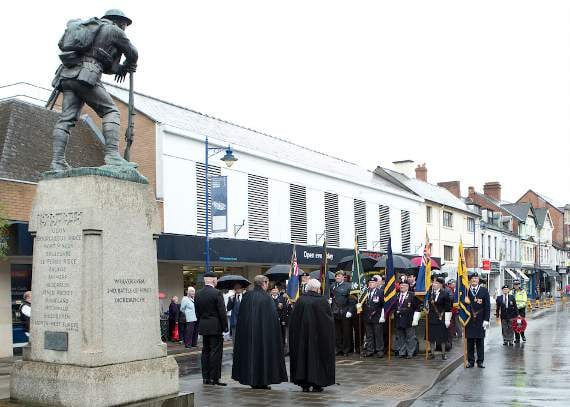
We would stand in the cold, flags lowered, as wreath after wreath of poppies, symbols of resilience and of life returning to a shattered earth, were laid wordlessly at the base of the cenotaph by men in berets with medals pinned to civilian overcoats. We stood as a community, stunned into respectful silence by the sheer scale of the slaughter.
A whole century has now passed and there is not a single combatant from that terrible conflict left anywhere on Earth. The last British WW1 veteran, Harry Patch who died in 2009, said, ‘All those lives lost for a war finished over a table - now what is the sense in that?’
And this year, on the hundredth anniversary of the eleventh hour of the eleventh day of the eleventh month when the guns fell silent, it’s not a question I can answer - and I don’t think Old Jack could have either.
Comments
This article has no comments yet. Be the first to leave a comment.