
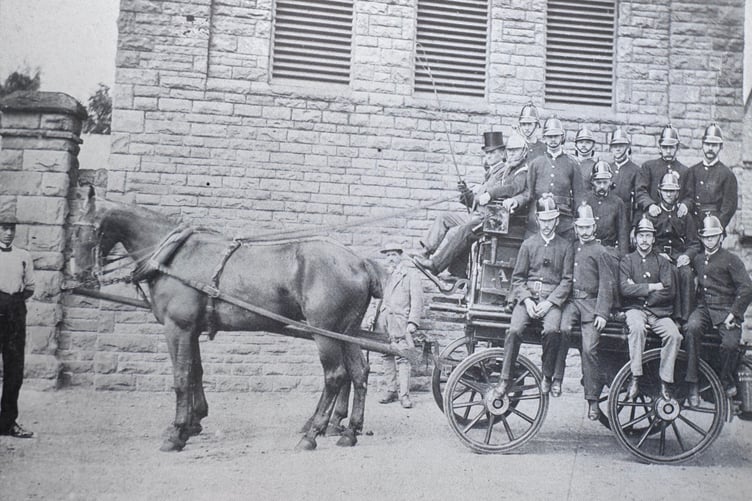
IN light of the recent wildfires, here’s a fitting rocket from the crypt for you.
It’s the Abergavenny Voluntary Fire Brigade pictured on their annual outing in 1900.
“Where were they going?” We hear you cry! Well, that particular year, they were heading to Llanthony Abbey.
Until the passing of the Fire Brigade Act in 1938, outside of London, authorities had no legal requirement to operate a fire brigade.
Abergavenny, like elsewhere, relied solely on volunteers to fight the flames.
About a century before the passing of the Act, Aber did possess two fire engines. One was a hand pump, the other a larger steam fire engine.
In 1837 it was undergoing some intensive repairs when a large fire broke out in Frogmore Street.
It was said to have started in the home of a cooper named Mr. Baker.
The Hereford Journal of December 4, 1837, reported, “On Wednesday morning last, the inhabitants of the town were aroused from their beds about six o’clock by the fearful alarm of fire. It was soon perceived, by the direction that the crowd was taking, where the devouring element was exerting its destructive power.
“The house of Mr.Baker was found to be enveloped in flames. In an incredibly short time, the street was filled with active, willing workmen, who without delay commenced operations to extinguish the fire.
“Every exertion was used to prevent the conflagration from spreading to the adjoining houses. The small hand engine was immediately brought to act upon the fire, but it soon got choked with gravel and was of course rendered useless. The only hope left, and an almost forlorn one, was the bucket.
“Two rows of men were immediately formed from the fireplug to the building, and a constant and copious supply of water was thus brought to bear; and so well was it thrown from ladders and through the windows, that by nine o’clock the danger of its further extension was over.
“Earlier, at about seven o’clock, so threatening was the appearance, that expresses were sent off to Monmouth and Hereford for engines.”
Back in the day, private individuals were responsible for paying for the services of the fire engines. The more severe the fire, the bigger the bucks.
Fire insurance plates used to be fixed to the walls of buildings to prove they were insured. Because in most cases the firemen would work for insurance companies and only put out the fires once they checked for the appropriate plates.
The engine in the pic was a manual Merryweather fire engine, and the men are pictured in front of the old fire station in Lion Street.
Captain William Henry Powell is seated up front with the driver, cab and coach proprietor George Bradley.
It was the cabby who owned the horses.
The firemen in this pic have just been kitted out in their new uniforms, which they had received from the Abergavenny Corporation.
Don't those helmets look smart?
Anyhow, it'd be interesting to know how many, if any, wildfires these boys had to deal with.
Comments
We've recently changed our login process. If you have an account for commenting, you will need to re-register on the login window.
This article has no comments yet. Be the first to leave a comment.