
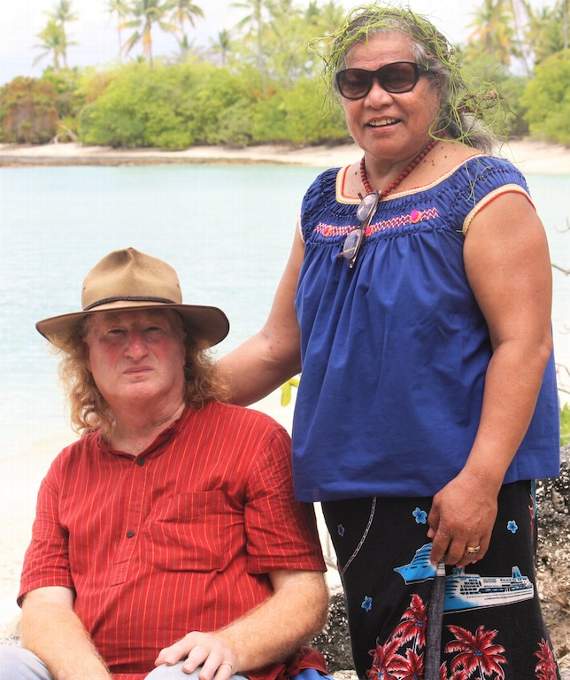
Swordfish, yam, paw paw, coconut and rice were all on the breakfast menu when a foreign head of state paid his first visit to his country’s honorary consulate in the UK - tucked away in a manor house near Penpergwm.
President of the Republic of Kiribati in the South Pacific, Anote Tong, has been a tireless campaigner on climate change for his twelve years in office.
Over the years, and especially in the last month, he has criss-crossed the globe to lobby everyone from President Obama to the Pope.
He’s spent the past month in Europe - in Geneva for a meeting of the International Organisation for Migration, Malta for the Commonwealth Heads of Government meeting, and latterly in Paris for the climate change negotiations.


Spending a couple of days in rural Monmouthshire was a rare chance to relax
It was good, he said, to ’just become an ordinary human being again for a while, have some traditional Kiribati food, and take some dogs for a few long walks in the woods’.
A tree was planted in the grounds to mark his visit.
While he was in Wales, after the final meeting of the Paris talks, he gave his negotiating team approval to sign the agreement - and at 7.30pm on Saturday December 12th he heard that the Treaty had gone through, better than he had hoped, although not with everything Kiribati would have liked.
A few bottles were opened at the honorary consulate to celebrate!
The President has known his honorary consul Michael Walsh for 45 years, since he was a university student and Michael was economic advisor to the Government of Kiribati.
On Michael’s first visit to Kiribati in 1971, the island was still part of the British colony, the Gilbert and Ellice Islands. The colony split into the sovereign states of Kiribati and Tuvalu in 1979.
For Michael, a two-year stay soon turned into five and in 1975 he married a Kiribati woman. He and Rotee (who is the President’s cousin) have three children and three grandchildren.
Although he left Kiribati in 1976 Michael was asked in 1996 by the then president to become honorary consul and he has held the job ever since.
Kiribati has three embassies - in Fiji, Taipei, and the UN in New York - and nine honorary consulates, in places like Australia, Japan, and Hawaii.
The fact that the nation’s honorary consulate in the UK is in Penpergwm, surrounded by open fields with the nearest shop about six miles away in Abergavenny, might seem rather eccentric…but the President, the First Lady (Meme) and their modest entourage seemed very much at home.
“The vice president has been here but it’s my first visit. I’ve been trying to arrange it for a long time and I’m delighted I’ve finally made it. I like it very much. It’s extremely peaceful and the surroundings are beautiful,” said the President.
Both adjectives could equally describe the paradise islands where he was born, whose inhabitants he says are by nature ‘a very happy people’
I thought I’d made a diplomatic gaff by referring to ‘Kiribati’ when it’s actually pronounced ‘Kiribas’ (one explanation being that the letters ‘s’ were ‘lost over the reef’ from a printing set that missionaries from the Boston Bible Society were taking ashore to produce a Bible for the islanders).
“Don’t worry,” he said. “Barrack Obama did the same. He was very apologetic."
I’m guessing that’s the first and last time I’ll be mentioned in the same sentence as the US president!
Kiribati covers a vast sea area and straddles the equator and the international dateline – the only country with a presence in all four hemispheres of the world. Scattered across this area are 33 atoll islands, in three archipelagos, with a combined total land area no bigger than Monmouthshire and a population of 110,000. The main atoll is Tarawa.
The main influence is Australian – ‘we use their dollar and drink their beer!’ – although mainland Australia is five hours away by plane.
The highest point above sea level on any of the atolls is 10 feet and you cannot be anywhere in the country much more than a quarter of a mile from the coast. Kiribati is thus in the front line of climate change.
The latest scientific projection is that within the 21st century, unless climate change is reversed, rising sea levels will put the islands under water, displacing all the inhabitants.
But there are short term problems too.
The atolls of Kiribati are experiencing increased wave heights and frequency, and this is placing increased pressure on the shoreline and seawalls. Storm surges occur far more often than in the past.
During recent ’king tides’ many people were affected by waves that reached nearly three metres, devastating some villages, sweeping farmland out to sea, and contaminating fresh water wells.
These high waves break over coastal land and seawalls and cause flooding and destruction to settled areas and fruit trees.
Cyclones and hurricanes are also occurring more frequently in the surrounding ocean. Earlier this year Cyclone Pam destroyed 80% of the buildings on its two most southern atolls, Arorae and Tamana.
In the UK occasional extremes of weather may prompt us to consider climate change. In Kiribati the inhabitants face the prospect that their homeland could one day be swallowed up by the sea and lost forever...
“At first climate change issues focused on the plight of polar bears," said the President. "We made the mistake of standing on the sidelines. But now we are being far more pro-active.
“We already suffer from severe flooding once a year but it is becoming greater and more frequent.
“We are providing some protective sea walls to prevent further inundation but some islands have already been destroyed and the inhabitants of others will have to leave within 10 years.
"We need to build up the islands but we don’t have the resources. We are hoping for money from the international community fund."
The President explains the crisis faced by his people in a feature-length documentary entitled Anote’s Ark. To view a trailer go to: arkarfilmusa.com/themovie
Anote Tong comes from a family of six brothers and sisters. Initially he studied at university in New Zealand then later at the London School of economics.
“A great deal has happened in my three terms as President but I suppose economic reforms are the biggest,” he said
In Kiribati the fisheries are the main source of income. 80% of the republic’s revenue comes from the licensing of fishing vessels from as far afield as Japan, Taiwan, Korea, the United States and Europe.
“The water around us is very rich in tuna – but it is being heavily overfished. We’ve taken steps to address this - creating a marine protected area of 440,000 sq miles.
“When I came to office I promised I would enhance our participation in the fishing industry and increase the rate of return. To this end I’ve started, but not completed, facilitating the use of local fish processing plants, so that the licensees will process their catch with us rather than take it back to their own countries.
“The move will create 1,000s of jobs.”
When Atone Tong gives up his presidency in the New Year he will still carry on campaigning on climate change but he will also be free to pursue his favourite pastime again – fishing, naturally!
"I’m going to go fishing with my grandchildren, who – provided we can implement what has been achieved in Paris – may now have a future," he said.
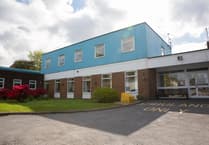
On his visit to Wales he was intrigued by the history of the honorary consulate.
Parts of the house date back to 1570 – but Bradney lists people living there in the early 14th century. According to Michael, it was one of the eight manors of the Lordship of Abergavenny – known as the Manor of Coed Morgan. In 1315 records show it was ’held for one quarter of a knight’s fee to provide archers for military service’ by the illegitimate nephew of John de Hastings.
“The Foreign Office aren’t really happy with the consulate being here in Wales – but this house has more history than any consulate in London and it’s set in much nicer surroundings!" he said.
Michael is unpaid in his role as honorary consul. He reckons his diplomatic work takes up around an hour or two a day.
One of his duties is to issue visas although, as Kiribati is one of the least-visited countries in the world, the workload is not taxing.
With barely any passports to stamp, most of his time is spent dealing with enquiries - usually 30 or 40 a week, by email.
Despite being Kiribati’s only representative in Europe, he is not officially a diplomat and his house has no diplomatic status. But as the honorary consul he is Kiribati’s representative on various international bodies in London.
In 2014 he helped the Kiribati Commonwealth Games team that competed in Glasgow, where they famously won a gold medal in weightlifting…
He is also responsible for offering consular support to all Kiribati citizens living in the UK – of whom there are currently only three.
The UK’s Kirabati ethnic community, however, numbers about 50 and most of them made their way to Letchworth on Saturday to a meeting with their President organised by Michael.
Having retired from his job as a management consultant, Michael is enjoying country life and, in particular, planting trees – 200 to date and counting.
The President’s visit was marked with the planting of a Chinese maple, noted for its striking red bark.
The VIP guest proved very hands-on when it came to the ceremony – turning the turf himself despite the immaculate suit and polished shoes!
The traditional Kirabati breakfast on Friday was followed that evening - after a trip to a local pub and tour of Abergavenny - by a British roast dinner, with veg from the garden!
Atone Tong will never visit Penpergwm again in his role as President - but Michael will continue to perform his duties as honorary consul to his adopted country.
He and Rotee only visit Kiribati occasionally - ’it’s a long way and very expensive’. When they do they tend to seek out ‘a good offer on flights!’.
Comments
This article has no comments yet. Be the first to leave a comment.