

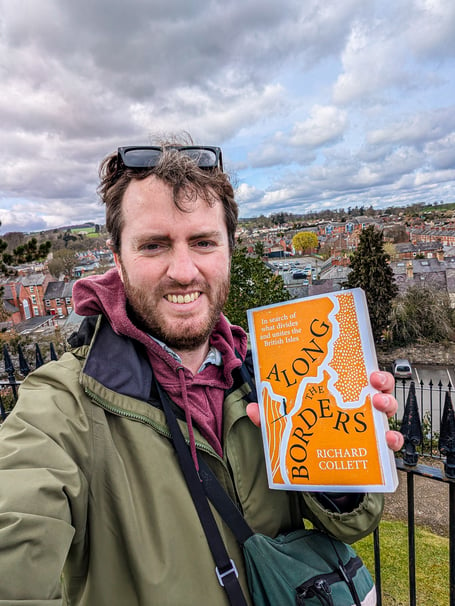
A NEW book that chronicles the author’s journey through hundreds of miles of Britain’s borders features Abergavenny and explores themes like Welsh independence, Welsh history, and the revival of the Welsh language.
Along the Borders, by Award-winning travel writer Richard Collett, journeys across the United Kingdom’s borderlands and frontiers to explore our increasingly fragmented regional identities and find out what it is that brings us all together.
Searching for a sense of national and personal identity in an increasingly fragmented United Kingdom, Along The Borders merges British history with contemporary politics and culture. Collett’s journey takes him to the banks of the River Tamar - a natural boundary dividing Anglo-Saxon Devon from Celtic Cornwall for a thousand years, to the English-Welsh borders, where Offa’s Dyke has separated the two countries since the 8th century. He then travels north to the Anglo-Scottish borderlands, Orkney and Shetland, and across the Irish Sea to Northern Ireland.
Richard Collett speaks to a cast of characters, including Cornish nationalists, Welsh speakers teaching Welsh in England, and migrant charity workers helping refugees.



-MCC-Chair-Cllr-Tudor-Thomas-and-Vice-Chair-Cllr-David-Jones.jpeg?width=209&height=140&crop=209:145,smart&quality=75)
For the first time in centuries, Brexit and the pandemic made hard borders an unprecedented reality. Calls for Scottish, Welsh, and even Cornish independence are a constant backdrop to Collett’s journey.
In Northern Ireland, there are fears of a hard border reigniting The Troubles, while in southern England, issues of immigration have turned the Kent coast into a maritime frontier and political battleground.
Collett explores the rise of regional identities in the midst of an ever-loosening sense of national unity, but ultimately, this isn’t a book about differences and divisions. Along The Borders is a travel book that tries to find what unites Britain.
Along the Borders by Richard Collet and published by Doubleday is available now.
Comments
We've recently changed our login process. If you have an account for commenting, you will need to re-register on the login window.
This article has no comments yet. Be the first to leave a comment.