
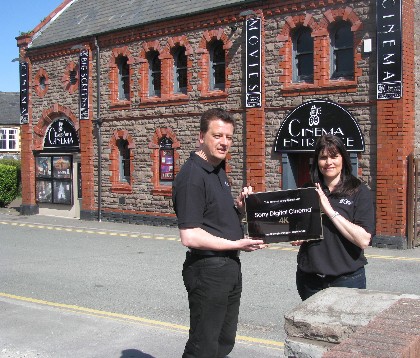
Abergavenny's Baker Street cinema is one of the first in the UK to introduce 'state of the art' Sony Digital Cinema 4K projectors.
The new technology offers moviegoers four times the resolution of a standard high definition television set as well as exceptional sound quality.
The major investment by owners Peter and Irene Davies coincides with the cinema's third birthday.
Since the beginning of moving pictures in the late 1800s all cinemas have projected 35mm celluloid film through a mechanical projector. But today a new Digital Era has begun.

.jpeg?width=209&height=140&crop=209:145,smart&quality=75)


At Baker Street and its sister cinemas - The Coliseum in Brecon and The Palace in Haverfordwest - Peter and Irene have installed six of the new generation projectors from SONY Digital Cinema Solutions.
These latest Sony SRX R515 Digital Cinema 4K projectors, straight off the production line in Japan, have been specifically designed for the independent cinema market.
"It's a huge step for us financially and personally but it's all about future-proofing our cinemas in the three towns " said Peter.
"Cinemas globally were rapidly being converted to the new digital technology and the pressure was mounting for us to do the same.
"The supply of conventional 35mm films supplied by the film distributors was decreasing at an alarming rate.
"It was getting more and more difficult to secure films on their national release date or even to secure copies in later weeks.
"Some films were not released on 35mm at all, so we were unable to show them in our cinemas.
"This was starting to make film booking increasingly difficult and it was only going to get worse.
"It was a case of 'convert or die', as it was likely that by the end of 2013 traditional 35mm film would no longer exist."
At a cost of around £45,000 per projector, however, a workable solution had to be found.
As an independent commercial cinema, applying for grants from the National Lottery or Welsh Assembly Government was not an option.
Fortunately SONY Digital Cinema Solutions made contact and offered the perfect solution to their dilemma. Working in partnership with Sony it would be possible, not only to digitise the six screens in three towns, but to bring the very latest in cinema technology to their rural audiences.
With Sony's Virtual Print Fee (VPF) programme, the transition to digital was made easier and more affordable. The scheme involves Sony helping to shoulder the capital costs for independent cinemas switching to digital.
Sony Digital Cinema then works closely with the major movie studios and distributors to subsidise the cost of exhibitors' technology transition on a 'pay per play' basis, as the film distributors no longer had to pay to produce 35mm film prints.
Sony's VPF programme dramatically cuts capital investment for independent cinema exhibitors, easing the cash flow, and the audience enjoys the benefits of superior 4K projection from day one.
Whilst the new projectors are capable of running the film entirely unattended, Peter and Irene still intend to treat each performance as an event in itself.
"Cinemas are our life - it's what we love doing. There's no greater feeling for us than a full house," said Irene.
"Going to the cinema is a great form of escapism. Whatever your problems at home you can come here for a night out, switch off and get absorbed in another world - and leave feeling refreshed.
"Our audiences will continue to receive the same high quality personal presentation they always have - with no compromises!"
Peter and Irene have booked a packed season of new films including: 'Star Trek Into Darkness', 'After Earth', 'Man Of Steel', 'The Great Gatsby' and 'Despicable Me 2'.
To celebrate the third birthday and the digitisation of the Baker Street Cinema, they are giving away three family tickets for four people......
Some frequently asked questions:
What does a digital movie look like?
* A typical 2 hour movie arrives in a box weighing around 25Kg containing around six cans of 35mm film each approximately 2,000 feet/600m long. These reels are joined together to play the movie. Each 'frame' (24 every second) can be 'looked at' and you can actually see the picture! This is projected mechanically, 12,000 feet from start to finish. When the movie's booking has finished, the six reels are separated again, packed into their cans and sent on to another cinema.
A digital movie arrives in a much smaller box on a secure portable hard drive about the size of a paperback book. The movie is 'ingested' into the cinema's projector where it is stored. An average movie would be about 300GB. The portable hard drive or digital cinema package (DCP) can then be sent to another cinema as it is not needed to project the film. The digital movie is then projected electronically.
What difference will this make to the audience?
* Some of the early digital cinema projectors were not very refined and it was obvious you were watching a 'digital picture'. The latest technology not only matches the quality of 35mm but exceeds it.
The Sony Digital Cinema 4K projectors produce a rock-steady picture with a corner-to-corner brightness and clarity.
Will you still be showing adverts?
* Yes - on-screen advertising is an important part of any cinema's income. Digital projection opens up the possibility of affordable short-term local advertising again too, through 'Pearl & Dean'. The cost of producing these on 35mm film had become prohibitive. So any local company can now advertise on the big screen alongside the national brands.
Does going Digital mean you will be able to show 3D?
* There are no current plans to install 3D at Baker Street Cinema. Peter explains: "Recent industry reports indicate that audiences are rejecting the premium pricing of 3D movies. We consider that, despite suggestions to the contrary a few years ago when 'Avatar' was released, 3D is not the 'future of cinema'. As previously, most recently in the 1980s, audiences are tiring of a gimmick that they have been forced to pay extra for. Most people hate the glasses!"
* Going digital opens up possibilities that were previously unavailable to cinema owners Peter and Irene - such as live concerts, sporting events or opera. They are currently assessing the viability of these events in small towns, bearing in mind the additional long-term investment they require.
Comments
This article has no comments yet. Be the first to leave a comment.