
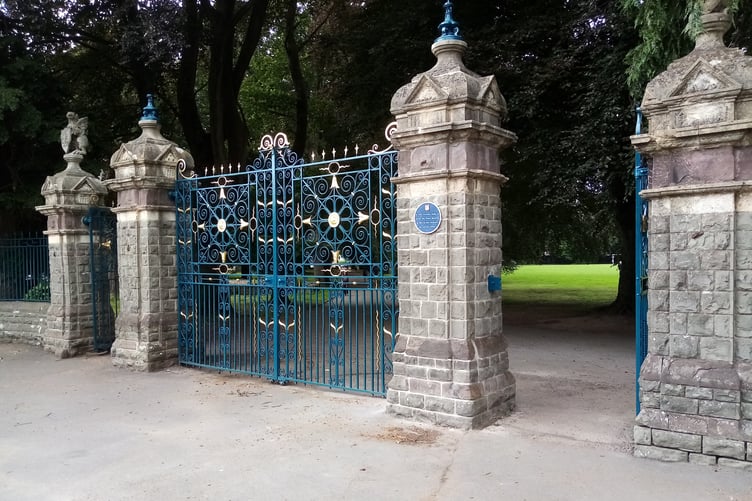
IN 2021 the ornamental gates on the Hereford Road entrance to Bailey Park were restored to their former glory after 134 years.
They are Grade 11 listed and the primary reasons for this are as follows: “A late Victorian public park, surviving in its entirety, which makes an important contribution to the townscape of Abergavenny.”
The park was laid out for the town by the prominent local ironmaster, Crawshay Bailey (this is not entirely accurate as the local ironmaster was Crawshay Bailey senior and the park is associated with his son, Crawshay Bailey junior.) The park has both ornamental and sporting components and its main entrance is particularly imposing.” But who was responsible for making those gates?
Crawshay Bailey, together with Edwin Tucker and E.A. Johnson (architect), addressed a meeting of the Board of Abergavenny Improvement commissioners in February 1883. The park would be under the control of a park keeper appointed by Mr Bailey who wished that the public should have full privilege of using the park except on reserved occasions.


Games would need a licence from the park keeper and there would be a schedule of charges. Mr Bailey reserved the right to let the whole of the park for special occasions that he would consider of benefit to the town. The Board was quite happy to agree to the plans as they were not called upon to finance any part of the proposed park except for the diversion of a few public footpaths. Crawshay then told the Board that Mr Johnson has my orders to proceed at once and planned that the new park would be opened in May, albeit some things may not be entirely finished by then. The park was officially opened on August Bank Holiday 1883.
HAMPTON & BROMLEY
Over the years Abergavenny has had a number of industries which have flourished but eventually died. One of these, which was a centre of activity many years ago, was Lewis’s foundry in Lewis’s Lane (the lane takes its name from the owner of the foundry).
The Abergavenny Street Survey records that the Lewis family were ironmongers from at least 1822 (Pigot’s Directory) until a Mr. James took over in the 1860’s. Mr James then combined with Edwin Hampton and the foundry subsequently changed its name to Hampton & Bromley in the 1870’s.
They had a shop in Frogmore Street on the corner of Lewis’s Lane and advertised brass bedsteads from 10/6 upwards, fenders, fire irons, table cutlery and galvanised iron buildings of every description in the 1850’s.
In 1884, Crawshay Bailey commissioned Hampton & Bromley to design and build an iron structure that would serve as a new assembly room for the church at Llanddewi Skyrrid and it is still in use today.
In 1895 there was an agreement between the Council and Edwin Hampton, iron-founders, for an unclimbable fence on the west side of the park.
Evidence of their involvement with Bailey Park has been found on an end post of the railings close to the south gate on Park Road. The post is embossed with ‘Hampton & Bromley’. (At the same time, the company was fitting a fence made with iron posts on the lane up to the new cemetery at Llanfoist, and every post is embossed with ‘Edwin Hampton, Abergavenny).
The north gate at the Park Avenue entrance has a central boss stamped ‘H & B/A’ (Hampton & Bromley – Abergavenny). The letters are hard to see as they are covered in many layers of paint that have been put on over the last 100+ years.
Strangely enough, the south entrance gates are very similar in design except that they do not have the central bosses fitted to them. So, we know that Hampton & Bromley made these two sets of gates and the perimeter fence.
On the 1881 census, Edwin Hampton is living with his first wife and family above their high street shop at 63 Frogmore Street and he is listed as an ironmonger employing 17 men and 7 boys. (His first wife died in 1891 and Edwin married again in 1894).
His father had advanced him some money to start up his business in Abergavenny but conditional on it being repaid around the time of his father’s death, or within 7 years at the latest, in order for the money to be part of his legacy to his other children.
Over £900 had been lent to Edwin but his older brother, Tom Hampton, took him to court in Bristol in April 1892 as Edwin had only repaid £500 and had reneged on his promise to repay the balance by the end of the year. The judge said that the plaintiff was entitled in his claim for the money (£459) but without costs being awarded.
In response to this, it appears that Edwin decided to form a new company called the ‘Tubal Cain Works and Stores- Abergavenny’ and shares were offered for sale in May of 1892.
One of the directors of the new company was Mr. James Straker. Hampton & Bromley also specialised in providing heating systems for large buildings but the company fell on hard times and the receivers were called in during 1896. The London Gazette of 23rd of May 1896 reported that at an extraordinary meeting of Edwin Hampton Ltd held at the Tubal Cain Works, it was resolved and duly passed that the company be wound up voluntarily.
Mr. James Straker of Abergavenny was appointed liquidator for the purpose of such winding up. A high court case followed to try and remove a Mr. Barford, official receiver, on the grounds that he had appointed Edwin Hampton as manager of the ironworks but that Edwin had since been carrying on business on his own account to the detriment of the company.
It was alleged that Edwin had entered into contracts on his own account to fit up hot water systems and that he had used tools, materials, horses and carts belonging to the company for his own affairs. It was explained that Hampton & Bromley had been an agent for a hot water firm based in Uttoxeter which had since gone out of business.
Mr Barford had given Edwin permission to carry on the agency but Edwin denied that he had ever used for his own business anything belonging to the company without paying for it. The judge said he would remove Mr. Barford from being the official receiver but he would remain until a replacement could be appointed. Mr. Barford was also told not to employ Edwin Hampton.
By December of 1897, the forced sale of Tubal Cain Works, by order of the mortgagees, was advertised in the press. James Straker was appointed to arrange the sale at auction. In 1888 the partnership between Edwin Hampton and William Edkins Bromley was officially dissolved and the following year, a creditors meeting was held in Merthyr Tydfil in order to salvage what they could from the failed company.
By 1901, Edwin and his family were living in a house on the Hereford Road in Abergavenny and he was calling himself a heating engineer and was working from home.
He and his family moved to Cardiff in 1905 to carry on his heating business. By the end of that year, he had to appear in court at Abergavenny as he was being sued by his second wife. In court, Edwin Hampton, described as a heating engineer of Cardiff formerly of The Hafod, Hereford Road, Abergavenny was charged by his wife, Elizabeth Hampton, with deserting her and the four children of their marriage and not maintaining them.
Elizabeth alleged undue familiarity on the part of the defendant with her lady housekeeper, who was a married woman with one child but separated from her husband.
Letters between Edwin and the housekeeper were produced in evidence as the contents were couched in affectionate terms. Several acts of violence were also alleged to have taken place between Edwin and Elizabeth when she had confronted him about his behaviour. Edwin finally left his home on 6th of November since which time he had contributed nothing towards the maintenance of herself and the four children. Elizabeth won her case and was granted maintenance. Sadly, Elizabeth died in 1911 aged just 49.
Edwin married again in 1919 to Barbara Ann Monk who was 19 years his junior.
Over the next few years, several large buildings were erected around the Cardiff area and articles appeared in the local press such as: A new church, All Saints, has been built in Barry and the heating has been most satisfactorily done by Messrs Edwin Hampton & Co of Cardiff. Edwin Hampton was still working up until the time of his death at his home in Cardiff in December 1926. He was 78 years of age. He is survived by his third wife, four daughters and two sons, Reg and Wilfred, who will carry on their father’s business. His personal effects in his will were valued at £1581. The funeral took place at the Old Cemetery in Abergavenny and the funeral cortege arrived by road from Cardiff and the chief mourners were his two sons, Mr. Alfred Shankland (a director of Hampton’s Heating Company Ltd.) and the four bearers were members of his staff. His wife died in 1958 aged 91. (Most local history books record that Hampton & Bromley made the Hereford Road gates but I have an alternative suggestion.)
By contrast, his partner William Edkins Bromley, moved with his family to Cheltenham where he established a laundry business.
GEORGE DAVIES (1842 – 1916)
The Abergavenny Chronicle of 30th of August 1918 records the death of Mr. George Davies at the age of 76. Although not a native of Abergavenny, he came here as a young man and started working at Lewis’s foundry.
In 1863 (at the age of 21) he started his own engineering and foundry business in King Street and called it The Lion Engineering Works after the neighbouring Lion Street.
When the telephone service began, the company’s telephone number was listed as Abergavenny 1. The business thrived and was taken over by one of his four sons when George retired in 1906. George Davies was a member of the old Board of Improvement Commissioners at the time Crawshay Bailey presented his proposals for the new park in Abergavenny.
George was also a member of the Abergavenny Urban District Council but his greatest interest was in poor law matters and he was a member of the Board of Guardians to the workhouse in Union Road. He also took an interest in the YMCA (established in Abergavenny in 1870) and was their president for some years and he had been actively involved with the provision of a purpose-built meeting hall that was erected in Frogmore Street in 1900. (A remembrance service was held there after his death.)
The church was also important to him and he was a warden at Christ Church in North Street which opened in 1880. George was also keenly interested in mission work and was largely instrumental in the erection of the mission hall in Abergavenny that was under the umbrella of St Mary’s Church.
George Davies contributed materially to the industrial life of Abergavenny in addition to the Lion Engineering Works. He was the principal founder of the steam laundry in Merthyr Road. His son, Frederick George Davies, worked there as an accountant and went on to marry the manageress, Miss Bernice Grace Lydia Miriam Develin in 1910 before moving from Abergavenny in 1920. An advert in the Abergavenny Chronicle dated 16th of May 1919 records that the steam laundry is now under new management. They had a son, Patrick Bernard George Davies, born in 1914 but at the age of 20 was a member of the East Anglian Aero Club. When the second world war broke out in 1939, he joined the RAF and quickly rose to the rank of squadron leader. He was mentioned in despatches in June of 1942 and he also took part in the ill-fated Dieppe raid on 19th of August 1942.
The Abergavenny Chronicle of 25th of September records that he was awarded the Distinguished Flying Cross for gallantry in flying operations. However, his luck ran out in 1943 and he was listed as missing until a German radio broadcast announced that he was now a prisoner of war in Stalag Luft 3 where he stayed until the end of the war. His grandfather, George Davies, lived with his wife, four sons and three daughters at Beechcroft in Harold Road which is now more familiarly known as Avenue Road Nursing Home.
The Lion Engineering Works went through many subsequent changes of ownership until it was bought in 1954 by Kibby Enterprises Ltd, a company that was owned by Colonel Harry Llewellyn, owner and rider of the world-famous show jumping horse, Foxhunter.
Colonel Llewellyn recalls in his autobiography ’Passports to Life’ that he had some splendid machinists, platers and moulders in the company but unfortunately, the moulders were a dying breed and there were no young men coming through to replace them. He closed the foundry and replaced it with an electroplating plant, but despite travelling the world looking for orders, the company began to lose money and so Colonel Llewellyn closed down the business and sold the site off for re-development. He recalled in his memoirs “It is also of little consolation to realise that 9 out of 10 similar engineering firms have gone to the wall.”)
HEREFORD ROAD ENTRANCE GATES
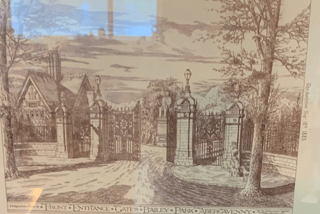
And now we come to the question of who manufactured the gates that have Grade 11 listed status. Edwin Arthur Johnson designed them and his original sketch shows that they were erected as planned.
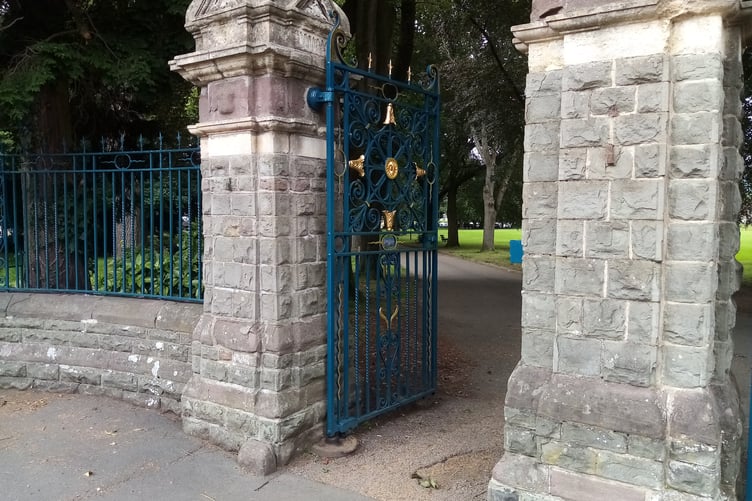
Knowing that one of the other gates had a maker’s mark “H & B” (Hampton & Bromley), I had another look at the Hereford Road gates but there were no visible marks. The base of the pillar on the left-hand pedestrian entrance was completely covered with a thick layer of leaves and other debris.
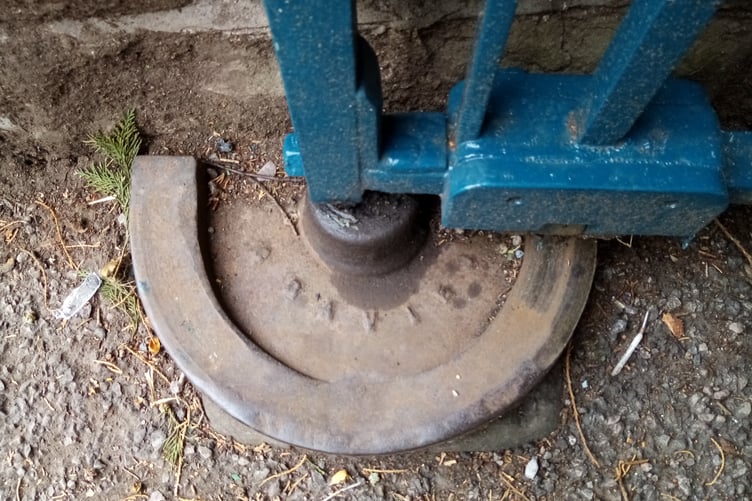
I cleared it all away and revealed a solid metal round disc on which the gate swivelled open and shut. After some more cleaning I could see the letters “G Davies” stamped on the plate and I knew that this was a reference to George Davies of The Lion Engineering Works. But why did this one gate have this plate and not the other three. Was this plate part of a later repair job?
The answer came from the company, Paul Dennis and sons, who were doing the restoration work on the gates. They said that it was an original fitting and was part of a self-closing mechanism.
The idea being that the other three gates would normally be closed but the left-hand gate would allow pedestrian access to the park and would self-close after use. This principle is still in use today as the main gates are only opened on special occasions such as the Steam Rally.
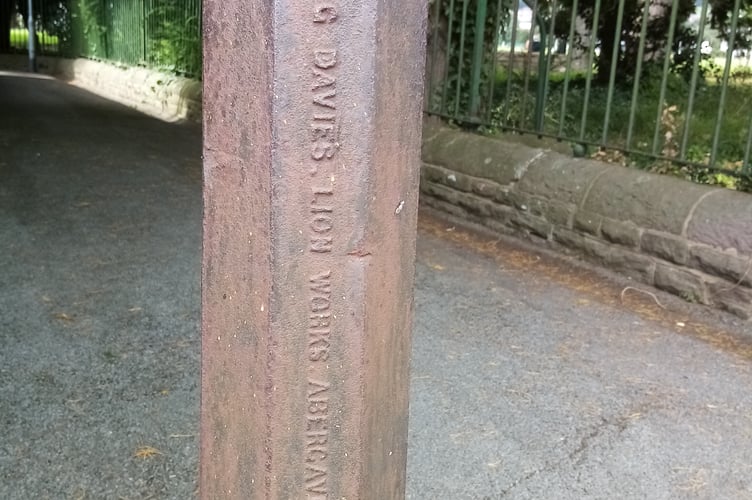
Furthermore, there are two metal bollards close to the railings, next to the pub, that are stamped “George Davies Lion Engineering Works.” Knowing that George Davies was on the Board of the Abergavenny Improvement Commissioners at the time that Crawshay Bailey laid out his plans for the park, I think it is reasonable to conclude that his company made the Hereford Road gates in the Lion Engineering Works.
Comments
We've recently changed our login process. If you have an account for commenting, you will need to re-register on the login window.
This article has no comments yet. Be the first to leave a comment.