
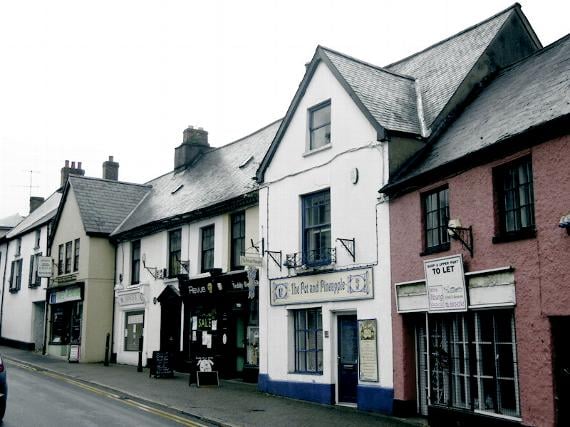
The newly renamed Plas Gunter Mansion project has received a boost from Abergavenny Town Council with a £1,000 grant towards the running costs of the building and promotional and marketing activities.
The project is made up of a group of volunteers and it is hoped that the activities funded by the grant will increase support and generate more income through donations.
The exhibition space, on the ground floor of the building, has had a facelift following a re-branding exercise. The mansion has been relaunched as Plas Gunter Mansion, as Plas is the Welsh word for a manor house or mansion, reflecting the Welsh heritage of the building.
Andrew Smith Creative developed the new look and its Early-Modern colour palette as a donation to the project. The new website is at: plasguntermansion.org.uk and the new colours can be seen in all their glory at the pop-up exhibition space. Volunteers clocked up an impressive number of hours painting the space and rehanging the exhibition boards earlier in the year.



“Those few months were very busy ones for the volunteers at the Plas Gunter Mansion project,” says Chair, Owen Davies. “It is our volunteers who helped develop the new branding, the project website and the face-lift, preparing the public exhibition space for this year’s visitors.”
The Grade II listed mansion, which dates from around 1600, is historically important because its owners were practising Catholics when this was illegal. They built a chapel in the attic where Catholics worshipped in secret. The chapel remained hidden for over two centuries until it was rediscovered in the early 1900s.
As well as helping with basic running costs like heating, lighting and repairing the space the Town Council grant will also go towards a shop-front sign with the new Plas Gunter Mansion branding and improving the exhibition material and artefacts on display.
“While we are very fortunate to have a willing group of volunteers to run the exhibition space and to run the marketing,” says Owen Davies, “we are going to need the skills of professionals to help develop our projects at a technical level. The grant will help to fund the production of high-quality promotional materials that can be displayed at the museum and other venues for visitors to take away, among other things”.
The Welsh Georgian Trust which saved the mansion for Abergavenny in 2017, following a successful appeal, announced last month that it had secured a grant from the Heritage Lottery Fund of £10,000 to add to the £5,000 already pledged by the Architectural Heritage Fund towards an in-depth archaeological and building research survey.
Following a successful competitive tender, local architects firm Morgan & Horowskyj are carrying out the survey and its team of historical building experts are expected to report on its initial findings towards the end of this month.
The two grant bodies recognised that the project is of local and national significance and that the proposed renovation and eventual use of the building - with its residential accommodation and retail space - makes it a sustainable restoration prospect.
The house is currently in a poor state of repair and urgently needs restoration if it is to survive. The plan is to restore original external and internal features and remove later alterations and additions that are not in line with the architecture from that particular moment in history.
The shops will remain but the historically important rooms will be open to visitors, allowing the building to be financially self-sustaining while allowing the public to see the significant rooms and features.
The vision is to turn it into an educational, historical and community resource, celebrating its local roots whilst attracting national and international visitors. This will also help to regenerate the area of town at the lower end of Cross Street.
The permanent exhibition in the pop-up space charts the fascinating history of the building in photographs and information boards. Monmouthshire society in the late 1600s was riven by conflict between Catholic and Protestant supporters. Catholic worship was forbidden under Charles II because of paranoia about a plot involving the French and Spanish to murder the King and replace him with a Catholic monarch.
The exhibition tells how the owner of Llanfihangel Court, John Arnold, denounced the two Catholic priests who held secret mass at the Gunter mansion, leading to their arrest and execution at Usk. One of them, Fr David Lewis, was made a saint and was Wales’ last Catholic martyr.
The other half of the pop-up space is available to local community interest groups to exhibit information. If your group is interested please contact Rob Willbourn at: [email protected]
Comments
This article has no comments yet. Be the first to leave a comment.