
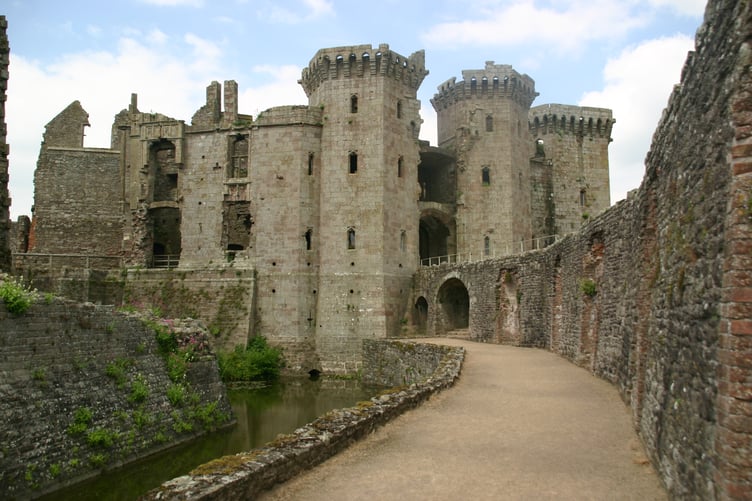
I was just eight years of age when my parents took me to Raglan Castle (Castell Rhaglan), and in those days my father did not own a car, so we travelled to Raglan by bus, to walk from the village up a lane that led directly up to the castle. Sadly, today the only approach is by car to follow a lane signposted from the A40.
Over the years, I have been there countless times, for it is without doubt the finest of Monmouthshire’s many castles. We can not only proudly boast that Wales has more castles per square mile than any other country in Europe, but Monmouthshire has more per square mile than any other county in Wales !
Raglan Castle was one of the last medieval castles to be built in England and Wales, and although formidable in appearance it is still very impressive as a ruin and was essentially a castle built as a residence of splendour and comfort, while as a stronghold, it was well designed to withstand cannonballs rather than just arrows.
It was William ap Thomas, Earl of Pembroke in the 1430s who was responsible for building the five-storey hexagonal Great Tower on the site of an earlier motte-and-bailey castle. It stands in moated isolation from the rest of the castle, and is often referred to as the Yellow Tower of Gwent. This is because it is constructed in pale almost yellowish sandstone, quarried from Redbrook on the river Wye. The walls are about ten feet thick and the remains of large fireplaces are visible because two of the six sides were demolished during the Civil War.
William Herbert added the great gatehouse which is flanked by pentagonal towers, three storeys high and joined by a battlemented portcullis chamber. He also built two courts which were known as the Stone Court and the Fountain Court. In the latter, there used to be a large white stone horse, mounted on a high pedestal, with mechanically driven jets of water playing upon it. The mechanism was designed by the Earl’s son Edward Somerset, the 2nd Marquess of Worcester who died in 1667.
It was the 1st Marquess of Worcester, a descendant of William ap Thomas who greatly enlarged the castle and this is not surprising for he was one of the richest men in the realm. He built the main gateway to the castle, and around the moat runs a sheltered terrace with several recesses in the wall, each of which once contained a statue of a Roman Emperor.
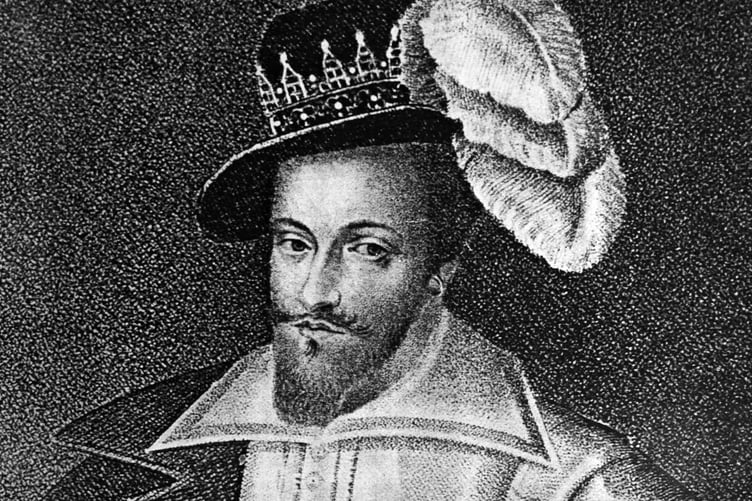
During the time of the Civil War, Sir Henry Somerset, the 1st Marquess of Worcester, was an ardent supporter of King Charles I. He raised a Royalist army of 1,500 infantrymen and 500 cavalry, which were maintained entirely at his own expense. He also loaned the King about £100,000 in cash, and if he had not done so, Charles I would have been bankrupt during the first six months of the war.
Sir Henry Somerset had a staff of 150, all living within the castle. They included two knights, several pages, masters of the horse, gentlemen of the chapel, gentlemen of the chamber, masters of the wardrobe and armoury, chaplains, keepers of the records, clerks, auditors and surveyors.



On July 3 1645 King Charles paid his first visit to the castle just after his disastrous defeat in the Battle of Naseby. He was entertained by the Marqess in royal fashion dining in the great hall with its magnificent fireplace. He stayed there for two months and saw the castle garrisoned on his behalf.
During the following year Raglan Castle was besieged by 2,000 men under the command of Colonel Thomas Morgan. It was now the only castle in Monmouthshire left on the king’s side.
But it was not until Sir Thomas Fairfax arrived in August 1646 to surround the castle with 3,500 troops that it was taken after a ten week siege. Letter after letter had been sent into the castle imploring the 80 year old Marquess to surrender, but he still refused, stating that he would ‘rather die nobly than live with infamy’.
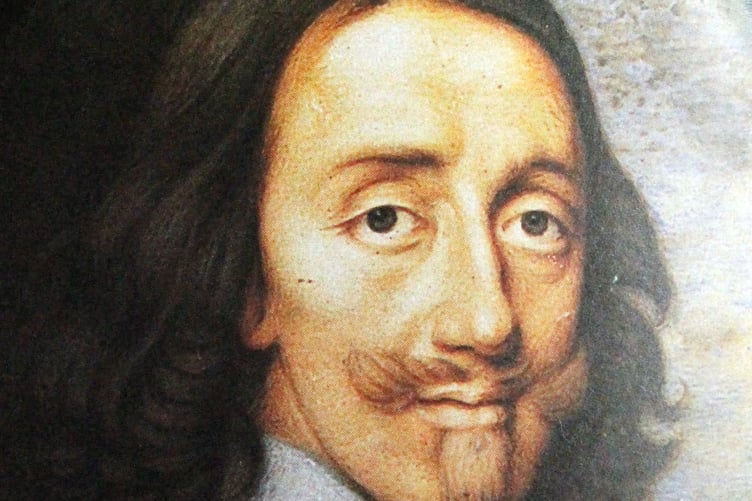
General Fairfax responded by redoubling his efforts and two weeks later on the 10th of August the Marquess asked for terms of an honourable capitulation. His garrison of soldiers headed by their officers marched out of the castle with full arms and their colours flying. There were four colonels, 22 captains, 16 lieutenants, six cornets, four ensigns, 52 esquires and gentlemen, making in all, with the ‘common soldiers’ 700 in total.
The Marquess of Worcester, when taken prisoner, was told that he could expect no mercy, and that his property would be confiscated. He was well into his eighties and Parliament gave permission, that on his death he could be buried in in St George’s Chapel, Windsor Castle, and he certainly had a sense of humour for he said’ ‘God bless my soul, I shall have a better castle when I am dead than they took from me whilst I was alive.’
A month or two later, on Christmas Day, he passed away, and was given a grand funeral, at the expense of his estates, to be buried in the vault of the Chapel of Our Lady later renamed the Beaufort Chapel in Windsor Castle.
Raglan Castle was deliberately destroyed on the orders of Cromwell, first with pick-axes and then by undermining the Great Tower. Unfortunately, the library which was considered one of the finest in Europe, was totally destroyed and the estates of the Marquess were confiscated by Parliament. The fall of Raglan Castle virtually marked the end of the Civil War, and in due course this magnificent building became a good source of local building materials and a romantic ruin, while today it is an important tourist attraction administered by Cadw the Welsh Government’s historic environment service.
One of my most memorable visits to Raglan Castle was on the August 17, 2006, when I watched a dramatic and colourful re-enactment, held to mark the 380th anniversary of its surrender to General Fairfax by the brave Marquess of Worcester.
Comments
We've recently changed our login process. If you have an account for commenting, you will need to re-register on the login window.
This article has no comments yet. Be the first to leave a comment.