

Abergavenny’s Castle Meadows, home of the 2016 Monmouthshire and District National Eisteddfod of Wales, has been judged as one of the top green spaces in Wales reports IRENA MORGAN.
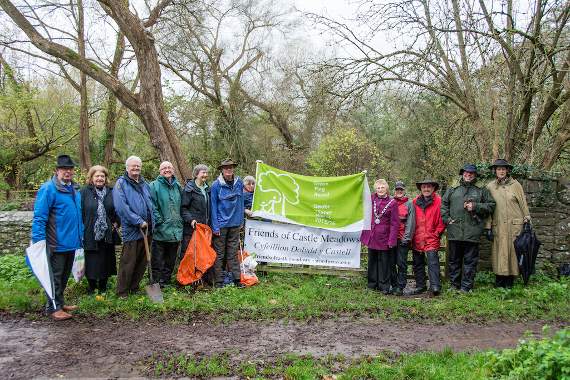
The riverside meadows, just a short walk from the town centre, have again won the coveted Green Flag award from the leading environmental charity Keep Wales Tidy, one of only three such awards given in Monmouthshire.
Owned by Monmouthshire County Council, the site is managed by the Friends of Castle Meadows’ volunteers who work in co-operation with the council’s Countryside Services to conserve the meadows as an important natural habitat.
Last Saturday, members of the Friends’ group were joined by the Countryside Head Warden, Mark Langley, countryside services’ volunteers and local councillors to unfurl the flag in the Castle Copse at the meadows in celebration.
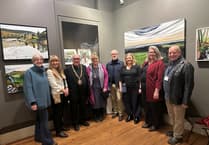


The Mayor of Abergavenny, Councillor Maureen Powell, congratulated the team for their work in retaining the award.
The meadows, a 20-hectare floodplain for the River Usk, are popular with walkers, cyclists, families and dog-walkers; they contain small copses, streams and ponds, and are home to a wide diversity of wildlife and plants.
Next year will see a major transformation when Castle Meadows become the Maes, the main venue for the Monmouthshire and District National Eisteddfod to be held between July 29 and August 6. The National Eisteddfod last came to Abergavenny in 1913.
Although there had been concerns about the effect that the festival could have on the landscape, flora and fauna, Helen Trevor Davies, Chair of the friends’ group, said that the land was resilient.
“Other sites for the Eisteddfod have all recovered, and what an honour it is to have such a prestigious event here.
“Let’s hope we can be open to the opportunities this event will afford, and we would welcome any enhancements such as hedging once the restoration of the meadows takes place.”
Last week, the Friends’ group met Huw Aled Jones, Head of Technical Services ?for the National Eisteddfod, to discuss the timetable for the temporary transformation. He had already held a meeting with town councillors.
He said that over the nine days of the event, a daily attendance of up to 20,000 people would be expected.
Work in Castle Meadows will start in early June to build a temporary service road and walkways to create the Maes with its main pavilion, a yurt, an open-air stage and tents for concerts, performances and exhibitions showcasing the best in Welsh literature, music, art, song and dance.
Surveys had shown that the best area for the main pavilion would be between two sets of trees, to minimise land levelling. Other areas would house a technical compound, broadcasting facilities for BBC Wales and S4C, traders’ stands and catering facilities. Some areas of the meadows would be avoided.
A mesh fence would be installed around the compound for health and safety reasons possibly with hoardings for updates.
The main entrances for visitors during the Eisteddfod would be from Byfield Lane and Mill Lane. Park and ride drop-off points would be at Byfield Lane with an area for disabled parking.
The riverside walk and cycle paths would remain open but another path could be diverted. There would still be access over the Gavenny Bridge footbridge to the town centre. However, the path that runs through the middle of the meadows, which was not a right of way, would be closed off.
Restoration work on the whole site would be completed by mid September.
Alwyn Roberts, Deputy Organiser, said the proximity of the Maes to Abergavenny town centre, offered an unprecedented opportunity for the town’s groups to get involved to organise guided walks and other events. A number of venues in the town centre such as church halls would be used for preliminary events.
Helen Trevor Davies, chairman, said this was an exciting time for the Friends’ group. They wanted to develop the site as an educational and recreational resource supporting walking and cycling.
Over the next year they were hoping to double membership, a Young Friends’ group had been set up in partnership with schools, and with the help of Green Valleys, a copse management plan had been drawn up.
A ‘bioblitz’ and environmental awareness days with schools have been held, and so far, these have recorded 324 different species.
A bid for grant funding had been made to produce a leaflet containing information about the meadows with QR codes linked to the Friends’ website.
The Friends organise regular themed walks on birds, botany, butterflies, dragonflies, moths, landscape, myths and foraging with expert guides from Countryside Services and groups such as the Gwent Wildlife Trust and the Gwent Ornithological Society.
Each of the walks gave a chance to add to the list of different species found on the meadows. A total of 33 birds were spotted during a recent walk, including migrating sand martins who return each spring to their nest holes in the river bank.
Other walks listed 45 different grasses and plants including the southern marsh orchid; 18 types of moth with a ruby tiger and feathered gothic, and 11 different butterflies such as a red admiral all within a short stroll.
The next guided walk will be on Saturday January 9for a bird walk in the Meadows with Steve Butler.
The Friends control and monitor invasive species and organise regular morning sessions usually on alternate Thursdays and the first Saturday in the month.
For the next few months, the winter work parties will be concentrating on reducing the nettles in the copse.
More volunteers are always welcome, please check the website for dates and times.
For more information about the Meadows, see the Friends website (friendsofcastlemeadows.wordpress.com/) or follow on Twitter @AberMeadows. For English language updates on the National Eisteddfod please visit eisteddfod.org.uk/english/2016/
Comments
This article has no comments yet. Be the first to leave a comment.