
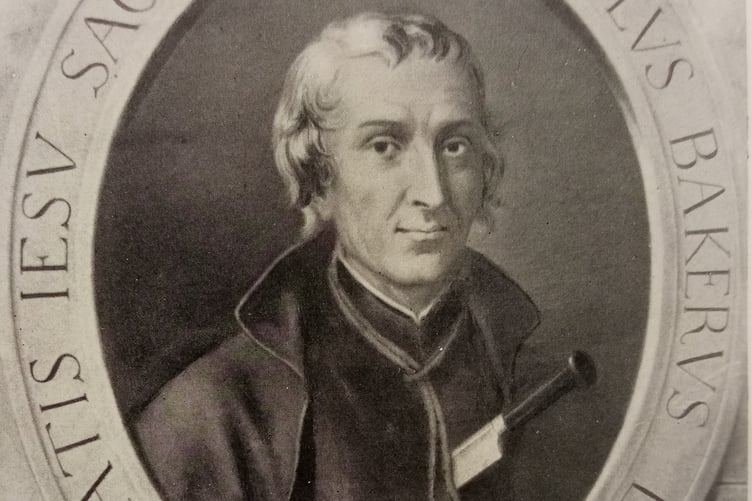
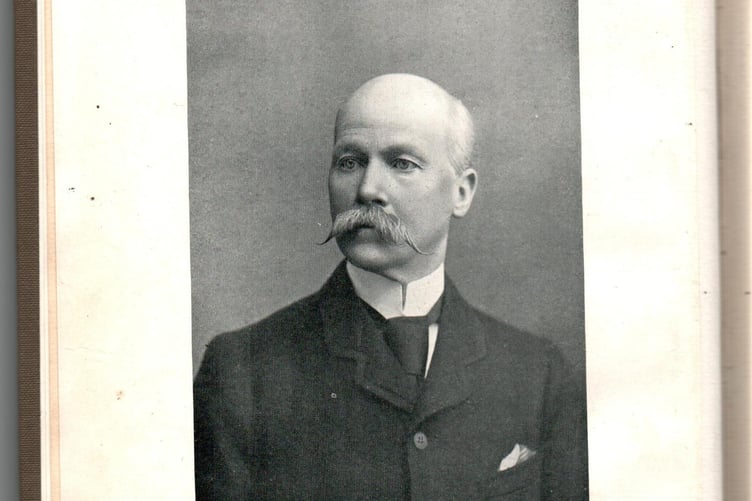
Richard Baker-Gabb, a well-known solicitor in Abergavenny up until his retirement in 1891, spent a year in convalescence during 1902.
As he was somewhat limited as to what he could do, he decided to look over the huge pile of family papers with a resolve to ‘weave and connect them together’ to form a continuous narrative of over 800 years of the Baker-Gabb family.
The result was a book entitled “The Families of Baker of Bailey Baker and Baker Gabb.” The relevant part of his book, that this story is about, concerns his ancestor Henry Baker who died in 1681.

Henry claimed to have 12 children, one of whom was called Charles Baker.
Richard Baker-Gabb then records that: “The following sketch of the life of Charles Baker, alias David Lewis, is here given, as many documents and memoranda relating to him are among the family papers, and as the belief was firmly held and frequently expressed by some members of the family that Charles Baker, alias David Lewis, was Charles Baker, the son of Henry Baker.”
Richard does admit that two books, one of which is a Bibliographical Dictionary of English Catholics, states that Charles Baker, alias David Lewis, was a son of Morgan Lewis, a master of the Grammar School at Abergavenny. Furthermore, the Diary of The English College At Rome has the following entry, “1638, Charles Baker (vere) David Lewis, a South Welshman, of the County of Monmouth, aged 21, was admitted as an (alumnus) November 16th, 1638; ordained Priest, July 20th 1642; entered the Society, April 19th 1644 (vir prudens et pius) – hanged for the Faith and Priesthood in the year 1680, in Wales.”
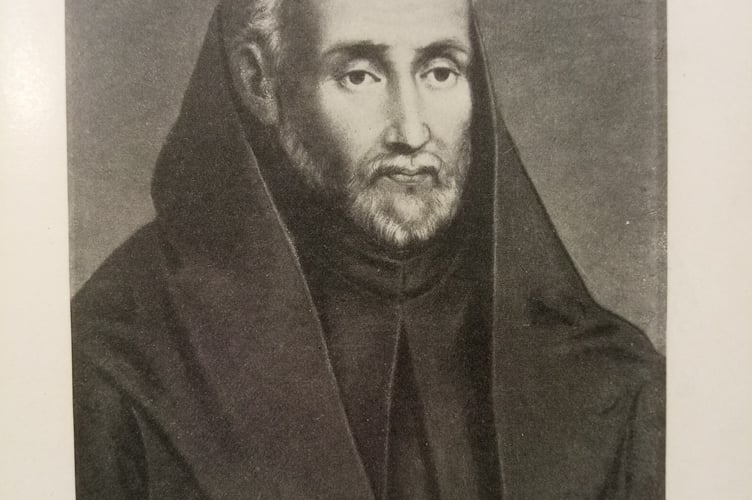
Another member of the family, in the previous generation, was David Baker who was born in Abergavenny in 1575. His father, William Baker, was the Receiver General of the Barony of Abergavenny and Recorder of the Borough of Abergavenny and his mother, Maud, was the sister of Doctor David Lewis, Judge of the Admiralty.
David became an ardent Catholic and took the name Father Augustine and lived through a period when anti-Catholic feelings ran high following the Gunpowder Plot of 1605. David died of natural causes in 1641 at the age of 66.
This was the same time that his nephew, Charles Baker, was in Rome starting on his Catholic career. The family believe that Charles had been influenced by his great uncle David Baker (Father Augustine.) Charles Baker had now entered the English College at Rome and in 1648 was sent on a mission to England, where in Monmouthshire, he carried on his ministrations.
The Baker family believe that he then changed his name to David Lewis in order to conceal his true identity – the name just happens to be that of his great, great uncle David Lewis, the Judge of the Admiralty!
All this is contrary to the prevalent understanding of who the real David Lewis was.
Sir Joseph Bradney clarifies this in his epic work “A History of Monmouthshire” and sums it up as follows: “David Lewis, the priest, also called Charles Baker, was the son of Morgan Lewis, master of the Grammar School, as is proved by the statement he made on entering the College of Jesuits – My name is David Lews alias Charles Baker. My father was Morgan Lewis and my mother Margaret Prichard, both Catholics, who lately died of fever. I lived at Abergavenny and was educated at the Royal Grammar School of which my father was principal.”
On his return to this country David Lewis became the head of a Catholic society at the Cwm, which is just on the Herefordshire side of the county border with Monmouthshire and he spent the next 31 years as a missionary in the area around Abergavenny.
This was at a time when ‘popery’ was causing concern to the authorities. In 1648 there were sixteen priests either living or associated with the Jesuit centre in the Cwm. The government were offering a reward of £20 for information that would lead to the arrest of a priest. John Arnold of Llanfihangel Court added another £200 to this reward.
Not surprisingly David Lewis was betrayed by a couple who had formerly been his servants.
David Lewis had already been named by John Arnold in evidence before a House of Commons committee the previous year who stated that he had known David Lewis for seven or eight years and he was reputed to be the leader of the Jesuits in the county of Monmouthshire and he was informed that he had said Mass at a popish chapel near Mr. Gunter’s house in Abergavenny.
Six soldiers were sent to Llantarnam where they arrested David Lewis on the 17th of November 1678 on the orders of John Arnold. On the 28th of March 1679 David Lewis was tried at the Monmouth assizes and the indictment read: “Thou, being a natural subject of the King of England, hast passed beyond the seas, and hast taken orders from the Church and See of Rome, and last returned back again into England and continued upwards of 40 days contrary to the Statute 27 Elizabeth, in that case made and provided, which by the Statute is high treason.” (Bradney comments that, “it is worthy of notice that throughout the trial he was referred to as David Lewis.”) David Lewis pleaded not guilty to the charge and conducted his own defence.
Richard Baker’s book details how The House of Commons appointed a committee in 1678 to consider “The danger the nation is in by the growth of Popery, and the remedies to prevent the same.” Many local people were summoned to give evidence to the committee, the two most prominent being Mr. Greenhaugh, the vicar of Abergavenny, and John Arnold of Llanfihangel Court who both gave lengthy statements.
Mr. Greenhaugh said, “That on Sunday and Holy days he hath seen great numbers of Roman Catholics resort to the house of Mr. Thomas Gunter, that there is the public mark of the Jesuits on the outside of the building, which is directly towards the Parish Church and he is informed that there is a chapel with Mass on Sundays and Holydays; that they have marriages and christenings by popish Priests and further that the said Thomas Gunter told him that in Oliver’s (meaning Oliver Crowell) time of severity he kept a priest and would keep one now.”
Furthermore, the book goes into great detail about the examinations of his forebear before his trial in March 1679 under the name of David Lewis.
Fifteen pages of the book describe the trial in great detail as well as David Lewis’s own statement. The clerk of the court started the proceedings by asking David Lewis, “What hast thou to say for thyself; Art thou guilty or not guilty?” The prisoner replied “Not guilty.” The clerk then said, “By whom will you be tried?” David Lewis replied: “By God and my country.”
The clerk responded by saying, ”God grant thee a good deliverance.”
After a lengthy trial during which David Lewis conducted his own defence, the jury went out but returned almost immediately with a guilty verdict. The judge asked David Lewis if he had anything more to say and the reply was “No, my lord.”
The judge then said, “ Give me my cap - David Lewis thou shalt be led from this place to the place from whence thou camest and shall be put upon a hurdle and drawn by thy heels forward to the place of execution, where thou shalt be hanged by the neck, and to be cut down alive, thy body to be ripped open and thy bowels plucked out, thou shalt be dismembered, and thy members burnt before thy face, thy head to be divided from thy body, thy four quarters to be separated and to be disposed of at His Majesty’s will. So the Lord have mercy on thy soul.”
The execution was carried out on the 27th of August 1679 near the river in Usk. David Lewis was allowed to address the crowd before he died and his speech takes up eight pages in the book.
It starts with the words, “Here is a numerous assembly I see; the great Saviour of the world save every soul of you all. I believe you are here met not only to see a fellow native die but with all expectation to hear a dying fellow native speak ….. (and finishing with) …. O holy Trinity, three persons and one God, from the bottom of my heart I am sorry that I offended thee, my good God, even to an idle word, yet through the mercy of thee, my God, and the merits of my Redeemer, I strongly hope for an eternal salvation.”
It is believed that someone in the crowd of onlookers made sure that life was extinct before the more gruesome parts of the execution took place.
The body of David Lewis was buried in the protestant church of St. Mary’s in Usk with a stone over the grave, on which the words ‘Popish Recusant’ were cut, and were said to be visible as late as 1830.
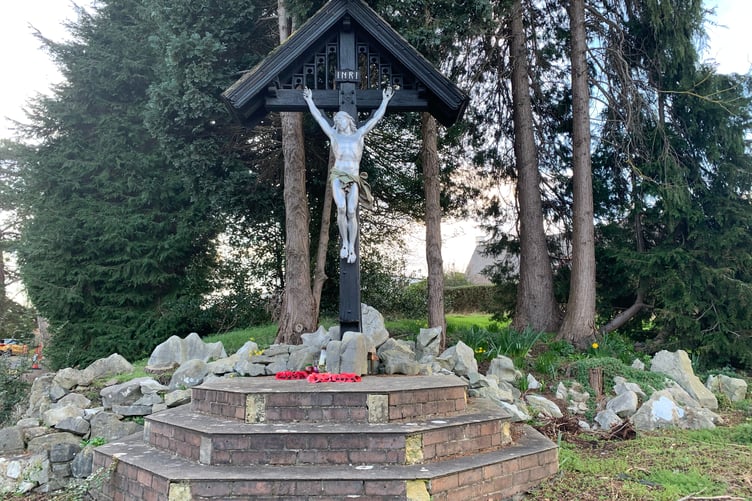
In 1847 a Catholic church was erected in Usk as near to the execution site as possible.
A Mr. and Mrs. Baker-Gabb were at the first Mass to be said in the new church. The original ledger stone at St. Mary’s church was by now reduced to a pile of cracked stones and these were removed to the new Catholic church and made into a shrine outside the church.
The church is known by the name: Saint David Lewis & Saint Francis Xavier Catholic Church and has recently undergone a refurbishment programme that has included provision of an inside chapel dedicated to Saint David Lewis.
The Roman Catholic Church in Abergavenny was opened in 1860 and a feature of the church is the High Altar reredos that was provided in 1883 by John Baker-Gabb in memory of his father.
He also erected the Chapel of the Sacred Heart in the south aisle, where the stained-glass window refers to two of his forebears: Saint David Lewis and Augustine Baker. There is an oil painting and small statue depicting Saint David Lewis. John Baker-Gabb was a Papal Chamberlain, in which capacity he served Pope Leo X111 for many years.
Comments
We've recently changed our login process. If you have an account for commenting, you will need to re-register on the login window.
This article has no comments yet. Be the first to leave a comment.