
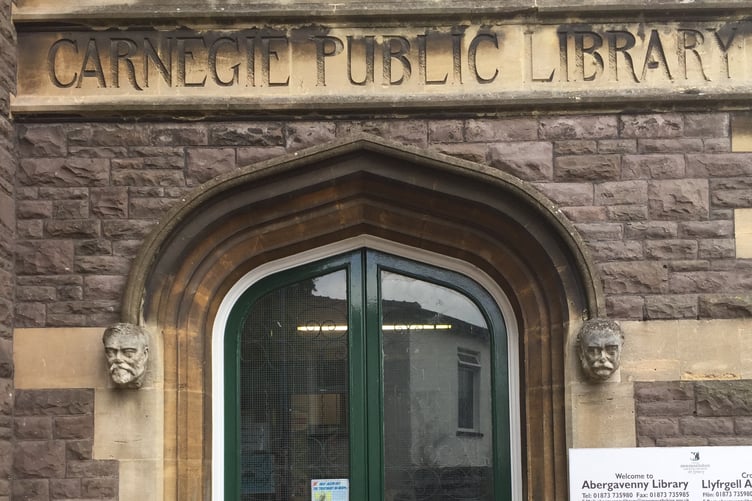
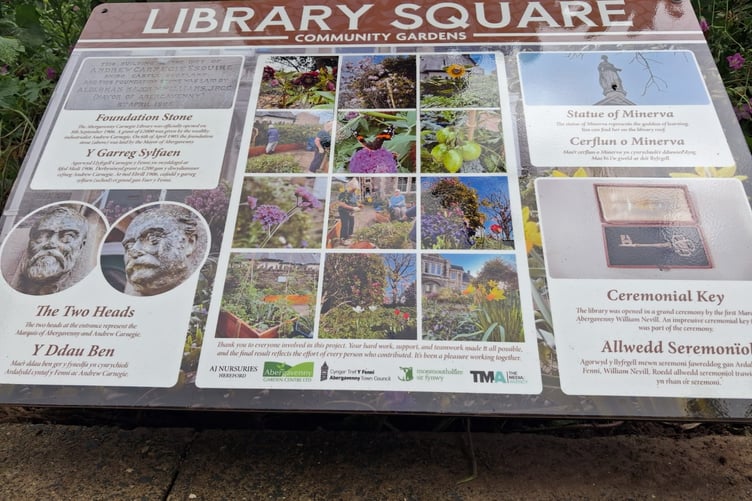
EVER found yourself staring, like a rabbit in the headlights, at the two stone heads on either side of the entrance to Abergavenny's old Carnegie Library?
They’re a formidable and fierce-looking pair, aren’t they! Yet who are they and what is their purpose? Were they carved in honor of two literary bouncers whose mission in life was to keep the Philistines from Monmouthshire’s Mecca of learning?
Or are they merely the equivalent of Victorian garden gnomes? Stuck on the library for purely ornamental and aesthetic reasons?
They are in fact, as is only fitting considering the great democracy of learning which public libraries ushered in, an aristocrat and a peasant. Or to give them their proper names - William Neville and Andrew Carnegie.
Their story is an interesting one.
The carved head on the right depicts Lord Abergavenny, or William Neville.
William gave the old Nevill Hall manor house its name and lived there for a number of years.
In 1899 he refused the Mayorship of Abergavenny but became the town’s first honorary freeman instead.
He also paid for and presented the first mayoral chain of office to the town. One which is used to this day.
The generous Lord officially opened Abergavenny Library on September 8, September 8, 1906. The man responsible for its funding was not. His name was Andrew Carnegie. He’s the stone head on the left and was once known as the richest man in the world.


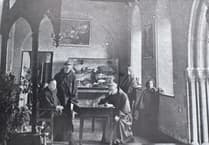
Unlike Lord Abergavenny, Carnegie wasn’t born with a silver spoon in his mouth. He was born dirt poor to a family who lived in one room of a rundown shack in Dunfermline, Scotland.
By the time of his death in 1919, Carnegie, who was once the renowned as the richest man in the world, had given away $5 billion in today’s money.
He gave to universities, he gave to museums, he gave to initiatives which supported science, the arts, and world peace, and above all, he gave to libraries.
Abergavenny Library is one such library.
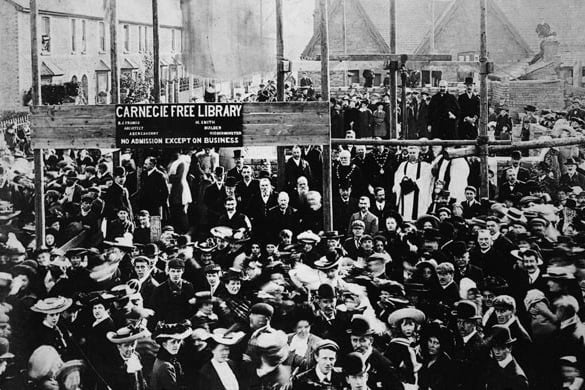
And last Friday, Library Square Community Gardens volunteers were pleased to unveil the new information board situated in the raised bed opposite the former library, which tells you all about the history of the library.
A spokesperson for the group told the Chronicle, "While working on the gardens and noticing how many people stopped to look at the Carnegie Library building, we realised that there was a need for an information board.
“The group contacted local historian George Beale who gave us some fascinating facts and the idea of a permanent record in situ was born.”
The spokesperson added, "The Town Council had given us an initial grant and continued to support the group. They suggested contacting The Media Agency. Finance proved a knotty problem, but Sue Parkinson and Monmouthshire County Council stepped in and gave us a grant to pay for the board, its erection and also for renewing the raised beds in the small garden behind the former library building.
“The lads from Abergavenny Garden Centre helped greatly and continue to support us in our plans and work.
"Thanks were also given to members of the public and AJ Nurseries who kindly donated shrubs,
“The project is part of our ongoing mission to maintain the gardens for the community of The Grofield area.”
Comments
We've recently changed our login process. If you have an account for commenting, you will need to re-register on the login window.
This article has no comments yet. Be the first to leave a comment.