
Next week’s Solar Eclipse promises to be one of the defining events of 2026 and people from across Monmouthshire will be looking to the skies when the moon crosses paths with the summer sun. But aside from it being an impressive natural phenomenon, the event could have very real consequences for some.
The 2026 eclipse path will closely mirror the journey made by Atlantic Fin Whales on their migration journey across the Arctic, Greenland, Iceland, the Atlantic Ocean and onto Northern Spain.
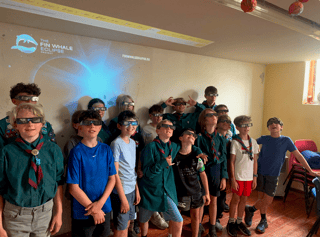
This discovery inspired the formation of a Canadian youth-led project, The Fin Whale Eclipse Project, to help one of the largest and most endangered species on Earth. They have partnered with Scouts in Raglan to promote the safe viewing of the eclipse and raise money to help conservation efforts for the species.
“Our goal is to help young people experience the eclipse safely while giving them a meaningful way to learn about science, nature, and conservation,” said Paige Denton, one of the founders of the project.
“The Scout groups are a perfect fit because they bring together community, education, adventure, and service.”
Participating Scout groups have received certified solar eclipse glasses and a Scout Eclipse Activity Booklet designed to help young people learn about the eclipse, safe viewing, astronomy, and conservation in a fun and educational way.
In 2024, the youth-led Canadian project also connected part of the North American eclipse with the migration of the endangered monarch butterfly, committing $75,000 to the conservation of the species. Now, the same principle is being applied to the whale population, which uses the moon as a way of navigation during migration periods.
The project will dedicate 15% of net proceeds toward whale and ocean conservation initiatives.
“A total solar eclipse is one of the most unforgettable events a person can experience,” said Emilie Leclercq, who has also worked hard to bring the project to life once again.
“But it must be viewed safely. We hope this project helps people prepare properly, while also drawing attention to the incredible Atlantic Fin Whale and the importance of protecting our oceans.”



The solar eclipse glasses, which use special filters made of black polymer or aluminized polyester film that block nearly all light and radiation. They reduce incoming sunlight by 99.999% (about 100,000 times darker than regular sunglasses) and completely stop harmful ultraviolet and infrared rays, and the Fin Whale Eclipse Project has been made the official supplier for venues across Europe, as well as groups like the Scouts in Raglan. They are:
· Festival d’Astronomie in Paris, France
· Planétarium de Mailly le Château
· The Municipality of Logroño, Spain
· Techniquest in Cardiff
· Société astronomique de France
Some of the organisers have even provided The Chronicle with a pair of their own ready for the big day!
Keep an eye on The Chronicle’s social media pages and website for the latest as we count down to the solar eclipse. It will be the greatest event of its kind since 1999, and experts predict a 93 per cent coverage of the sun here in South Wales.
Comments
We've recently changed our login process. If you have an account for commenting, you will need to re-register on the login window.
This article has no comments yet. Be the first to leave a comment.