
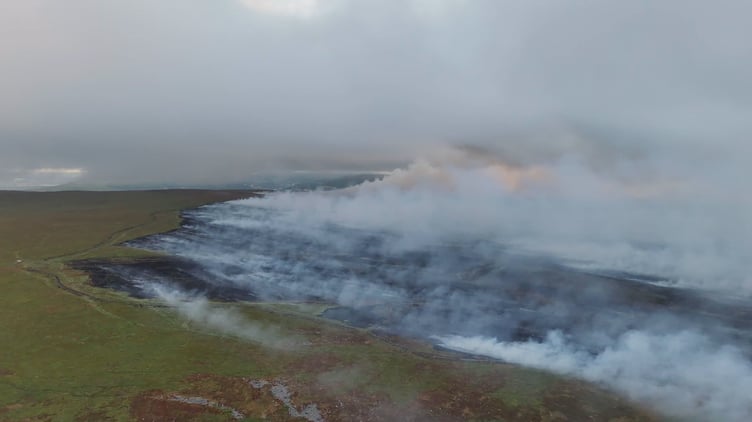
NOW that the flames have finally begun to fade and the smoke has started to clear, it’s time to tally the true cost of the wildfires that have plagued our mountains this summer, and like everything else left in the wake of a fierce inferno, it’s not pretty.
Behind the blackened hillsides, the dead wildlife, the missing livestock, the depleted peat and at times overwhelming stench of smoke, there are people who live and work on the mountains whose homes and livelihoods were in the direct firing line of the blaze.
Ffawyddog sheep farmer Julian Rees is one such person who has faced a huge upheaval from the fire that wreaked such rapid and relentless destruction on Llangattock Mountain.
Julian, whose family has used Llangattock Common to graze their sheep since 1965, told the Chronicle, “My son, Scott, and I each use the mountain to graze two flocks of sheep. Since the fire, there’s no ground left to graze. There probably won’t be much this time next year either, and in some areas there won’t be anything left for generations.
“The fire’s burned right through the peat until there’s nothing left but rock. It’s like a quarry up there now. It’s devastating. It looks like a crater where a bomb has gone off. We’re currently having to buy the food in to feed the sheep because there’s nothing left for them now.”
With flocks that number in their thousands rather than hundreds, that’s a lot of fodder.
Yet Julian remains grateful that with reports of sheep dying terrible deaths from smoke inhalation, he didn’t lose as much livestock as he could have.
“The sheep moved with the fire.” Explained Julian. “We’ve lost some, but we’re not sure how many as of yet, but it’s bad. At the height of the fire we had no real idea what was going on because you could only see a metre in front of you because of the smoke. The smell was awful, and although we’ve all gotten used to it by now, we’ve all still got constant sore throats.”
Julian added, “Thankfully we’ve had plenty of fellow farmers offering us animal fodder to keep us going, until things hopefully improve.”

Hopefully is the key word here.
As well as its loss of use as a grazing common the significant peat loss caused by the fires on the mountain will have a huge impact on the ground to hold and retain future rainfall, which will cause its own unique problems in the winter months.
Yet Julian remains doubtful the area will recover as a grazing common in his or his son’s lifetime and, like many farmers, remains critical of how Natural Resources Wales (NRW) has managed the land.
He told the Chronicle, “NRW have got to start working with farmers on an individual basis and not have a blanket approach to how we treat all commons.
“For example, one common could have a bog, and the other could have a lot of bracken and fern on it.
"Obviously one is more of a fire risk than others, but it doesn't seem to be an issue to someone who is ticking boxes in an office somewhere.
“And what happens is, a common that needs its bracken controlled and firebreaks maintained becomes neglected and a danger."
Julian added, “Llangattock common is a triple SSSI (site of special scientific interest), and in my view it’s under grazed. We’re not allowed to put out how more sheep than the rules state, and we’re not allowed to spray the fern, which then becomes a huge fire risk.
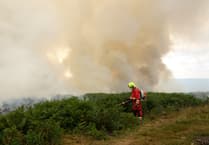
“What happened this year is you had green fern growing over the dead fern, and it just went up like torch paper. The firefighters couldn’t send anyone in because the fern was jut way too high, and you had this situation where the wind would blow up burning pieces of fern like a helicopter, and it would spread to other parts of the mountain and the fire would spread.”
Julian also pointed out that sheep have been grazed on these hills and blanket burns have been taking place for generations, and there’s never been a problem with wildfires until recently.
“We’ve had three in the last three years!” He explained. “This one has been by and far the worst, but they’ve all been deliberate.
“Once started, the way the land is managed and the dry conditions we’ve had this year make them easy to spread, but it’s a fact they’re arson.
“When the smoke was first spotted, two people were seen running away from it. It’s sickening, but that seems the way world is going now. But what can you do, you’ve just got to keep fighting the good fight.”
Yet through the hazy smoke and flickering flames there is a silver lining, and it’s how the fires brought the farming community together in their hour of need.
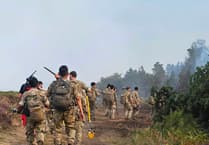
“The fire service boys were excellent in getting the booster pumps and everything up there, but the only trouble is because the terrain is so tricky you really need a tractor to navigate it and the fire brigade haven’t really got the equipment.” He said
“GT Jones Contracting pretty much saved the valley by bulldozing two firebreaks the flames couldn’t jump.
"There were a lot of farmers up there too pitching in and transporting water, and it was a nice reminder of what a tight-knit community we are.
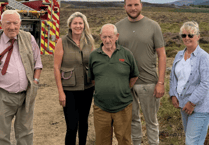
“But it wasn’t just about farmers and the fire brigade working together; the amount of support we received from the public was incredible.
“However. Like everyone else I just wish it hadn’t come to this. Farming doesn’t happen in isolation, and we’ll be feeling the effects of these fires for generations.
“We need proper management of these hills, and it’s time for NRW to start working with us and not against us.”
An NRW spokesperson said, “Reducing wildfire risk requires a collaborative approach. We will continue engaging with farmers and landowners on land management and wildlife resilience and recognising the important contribution they make.”
Comments
We've recently changed our login process. If you have an account for commenting, you will need to re-register on the login window.
This article has no comments yet. Be the first to leave a comment.