
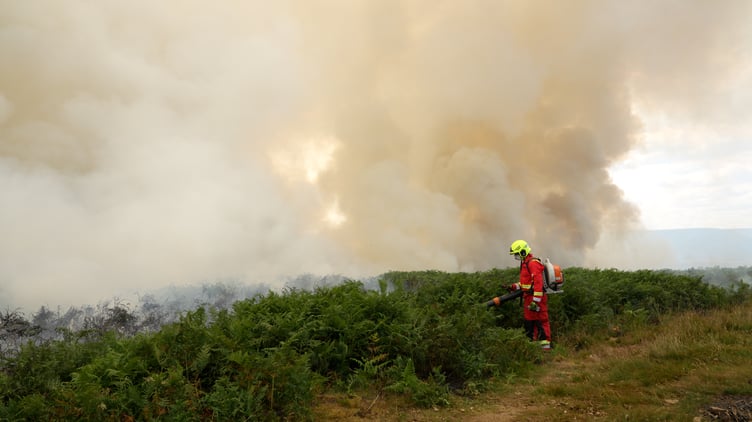
AIR quality in areas around Blaenavon was among the worst in the world as a result of the recent wildfires research undertaken by the charity Save the Children, which has come as a shock to Torfaen council which says it was unaware of the data or what evidence was used in the assessment to arrive at the reported conclusion
Torfaen Borough Council however has said it recognises prolonged wildfires “have the potential to adversely affect local air quality” and acknowledged “elevated particulate concentrations” have been observed during the wildfire period from its regular air quality monitoring.
The fire above Blaenavon, that started on July 19 was described by the fire brigade as “one of the largest and most challenging in South Wales in recent years” and contributed to a major incident being declared across the which eventually required assistance from the military.
Save the Children, which campaigns on and supports children’s health and addressing poverty, said it had examined data from the European Union’s earth observation programme Copernicus which tracks wildfires across the world and the impact of their burning.
The charity’s analysis of the data showed the intensity of the carbon emissions in Torfaen put it fourth in the world, after Annaba in Algeria, Ávila in Spain’s largest ever wildfires and Malanje in Angola.
Melanie Simmonds, head of Save the Children Wales said: “In Wales and across the world, children are breathing in smoke from wildfires, coping with extreme heat and losing the freedom to play outdoors because the air is no longer safe. These conditions are not only frightening – they carry serious health consequences for children whose bodies and lungs are still developing.”
A Torfaen council spokeswoman said: “The council was not aware of Save the Children’s research. Furthermore, it is not clear what data or evidence was used in the assessment to arrive at the reported conclusion.
“The council recognises that prolonged wildfire incidents have the potential to adversely affect local air quality, particularly through increased levels of smoke and particulate matter.”
The council continuously monitors air quality in Torfaen through a monitoring station in Croesyceiliog Cwmbran, with periodic data published on a council website.
“The Cwmbran site is officially designated an ‘Urban Background’ monitoring station and is not designed to be moved in response to localised incidents such wildfires,” said the spokeswoman: “However, data from this site provides an indication as to the general levels of air pollution in the wider environment.”


“While elevated particulate concentrations have been observed during the wildfire period, the council’s monitoring station is intended to provide information on general background air quality rather than conditions at specific locations immediately adjacent to the fires,” said the spokeswoman.
Professor Sarah Jones, consultant in environmental public health for Public Health Wales, said a number of factors lead to it deciding assessments of the impact of the smoke could be based on the fixed air monitoring stations in place across Wales.
Those factors included the “rapidly changing” fire fronts and wind changes across Wales, the “well understood” composition of the smoke and the heat causing smoke to rise to the atmosphere where it was diluted and reducing the concentration.
“At times, the fixed monitors recorded high and very high levels of air pollution, as defined by the daily air quality index,” said Prof Jones.
Blaenavon councillor Janet Jones said changes in the wind direction, and a welcome “drop of rain” have helped improve air quality locally but described smoke on Thursday, August 13, which was three weeks after the fire first ignited, as “particularly bad”.
The independent councillor said though she wasn’t aware of the research by Save the Children she will raise it with the borough council: “It is quite interesting and I will take it up with the relevant officers and it will need some sort of investigation.”
She described Blaenavon as an industrial area with many former miners: “There was great concern about air quality and the impact on elderly people and those suffering with respiratory issues such as emphysema and COPD.
“It hasn’t affected me personally, but I know other people have had issues, especially the people living in close proximity, and have had to put their washing out again or redo it.
“I have spoken to some of the GP nurses and asked if they’ve seen an increase in patients complaining, or showing concerns, of respiratory problems. I spoke to them two weeks ago and they hadn’t noticed any significant increase in that time, but it is something that could change in the months ahead.”
Comments
We've recently changed our login process. If you have an account for commenting, you will need to re-register on the login window.
This article has no comments yet. Be the first to leave a comment.