
INDEPENDENTLY run shops have always been integral to a town’s identity and were renowned for fostering a community spirit in a way which the sterile shacks of consumerism and torrid tombs of transaction that call themselves ‘supermarkets’ cannot.
Take a trip to any UK town and you will no doubt dazzled by the backlit and beckoning sign of an Asda, Tesco, or Morrisons looming like a prophetic angel in the empty skies announcing a new era of convenience and commerce.
Yet although the towns change, the supermarkets remain - uniform, impersonal, insipid, immobile and invaluable to an age that prides itself on pounds rather than personality.
Nevertheless it was not always so. Once a mainstay of UK high streets, small independently run shops have vanished in huge numbers from towns across the country.

.jpeg?width=209&height=140&crop=209:145,smart&quality=75)


But in losing them, have we also lost the traditional values that so defined society during their prime?
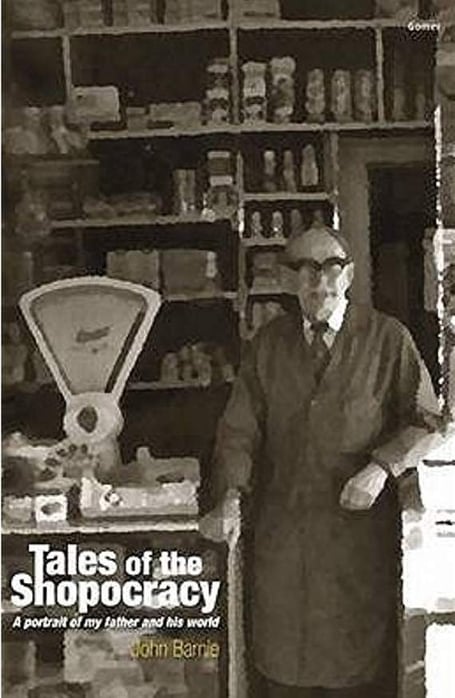
When author John Barnie was growing up in Abergavenny in the 1940’s almost all the families he knew ran shops and it is this way of life that is captured so vividly in the evocative account of E.C Barnie, Wholesale and Retail Confectioner.
In his new book ‘Tales of the Shopocracy’ John Barnie looks back over his father’s life as a small town shopkeeper, painting a portrait of a world where you worked hard to ‘get on’ where waste was a sin and debt was frowned upon. A world of churchgoing, caution and respectability, where ‘sex’ was a word never used, and where gardening, home cooking and the Empire were revered.
In short, Ted Barnie lived in a world long lost to many modern day readers, but it is also a world that will be remembered - and maybe missed - by a whole generation.
A world that John Barnie was determined to make a record of for the benefit of his son, as the author explained to the Chronicle, “Our son was born a year to the day after my father’s death, so my wife suggested I write a few things down about the granddad my child would never know.
“The book was born from there, and became an attempt on my behalf to evoke my father’s attitude towards the world he lived in. And as he was a shopkeeper, his attitude was very much part and parcel of his profession.”
In an economic and engaging style ‘Tales of the Shopocracy’ vividly captures a much different and smaller Abergavenny to the one we know today, as Barnie points out, “My father was born into a world of horse transport where an automobile still had to have a man with a red flag walking before it. Yet by the end of his life the roads were choked with cars, aeroplanes flew at supersonic speeds across the Atlantic, and the Americans had landed on the Moon.
“My father was part of the dilemma of a prosperous mass society in a way that he, like many others, never understood or come to terms with. Car ownership was an evident good which is why he bought one, but when car ownership spread, it became less good.
“The balance between the quiet small-town world he had grown up with and was at home in, and the process of modernisation which he had quickly embraced, became more difficult to maintain until the end of his life in the 1970s, it was destroyed.”
In a sense you could view the ‘shopocracy’, albeit in subtle way, as protagonists of their own downfall, as rampant and unchecked capitalism charted a course to its logical conclusion of monopolies and brand culture.
Yet as Barnie mentions in his book, “There is a dividing line between being a shopkeeper and being an entrepreneur and my father’s generation never crossed it.
“The skills and experience needed to run a sweet shop are different from those needed to run a tobacconist’s.”
Although it depicts a time that will never come again, Barnie’s memoir is far from shadowed in the rosy hue of nostalgia, and also highlights his own rebellion against the small town mentality that would have him conform.
In hindsight, he is quick to admit that it was ‘done in the crude and sometimes brutal way of teenagers’, attacking his parents core beliefs like a ‘terrier with a rag doll’.
Yet his was always a rejection of their beliefs , never of the people whom he loved and admits in the book that even when teaching for 13 years in Copenhagen Abergavenny and the borders were always on his mind.
“For some time I had a tuft of sheep’s wool picked up in the Black Mountains, which I would hold to my nose now and then for its muttony smell and which, along with the aroma of a frond of bracken crushed in the hand, is the smell of the border hills to me.”
In a time where waste was a sin, the era of the ‘Shopocracy’ was much less damaging to the environment than the disposable ‘chuck it and bin it’ mentality of today
Which leads to the question, was their existence more beneficial to the community than the anonymous superstores of today, “I think so, yes,” said Barnie, “Small shops keep towns alive and help contribute towards the town’s identity and character.
“You talk to the old shopkeepers and they are full of stories about the town and its history you will not find anywhere else, because they played such a defining role within the community. They are the human face of shopping that cannot really be found over the counter in a superstore.”
Barnie added, “I think in amongst the gloss and sheen of modern shopping centres, we are in danger of losing our identity somewhat. It is hard to find a human dimension in the sterile and bland atmosphere of the modern mall. And personally I found it quite an ordeal shopping in such places.”
•THIS ARTICLE WAS FIRST PUBLISHED IN THE ABERGAVENNY CHRONICLE IN NOVEMBER 2009.
Comments
This article has no comments yet. Be the first to leave a comment.