
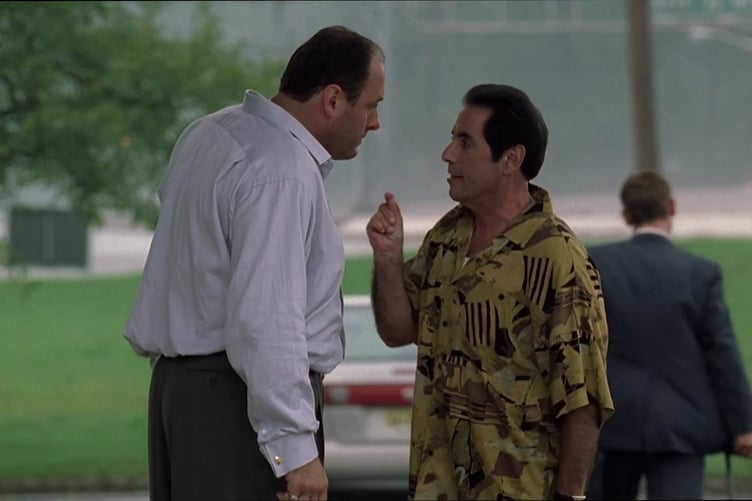
THE fictional but hugely influential TV series The Sopranos is regularly cited as the greatest television drama in U.S. history.
Across six seasons (1999–2007), it drew tens of millions of viewers, won 21 Emmy Awards and five Golden Globes, and was hailed by critics as the most important television series ever made — redefining the crime genre and reshaping modern storytelling.
Its haunting opening theme, “Woke Up This Morning (Got Myself a Gun),” became instantly iconic — a blues-gospel anthem that mirrored the moral chaos of mob boss Tony Soprano’s world.
Few viewers realised, however, that this unforgettable song was sung and co-written by a Welshman.
In The Fighting Welsh, Abergavenny author Andrew J. Sutton reveals that the voice behind The Sopranos belongs to Larry Love (born Rob Spragg), frontman of Alabama 3.
Despite their Southern-sounding name, Alabama 3 are not from America’s Deep South, but from Brixton, South London — with deep Welsh roots through Love, who was born and raised on the Gurnos estate in Merthyr Tydfil.
The son of a preacher, he grew up immersed in gospel hymns, working-class hardship, and chapel culture — a fusion of faith and survival that would later define his music.
Formed in 1995, Alabama 3 created a genre-defying sound blending acid house, country, blues, rock, and gospel — what Love famously described as “sweet pretty country acid house music.” Their lyrics explored crime, redemption, addiction, belief, and modern disillusionment — themes that aligned perfectly with The Sopranos’ portrait of America’s fractured gangster soul.
“We made music for the lost, the lawless, and the blessed,” Love once said — a line that could have been written for Tony Soprano himself.



The global success of The Sopranos propelled Alabama 3 from underground cult status to international recognition, placing the voice of a Welsh preacher’s son at the heart of one of television’s most recognisable soundtracks.
Adding to the band’s outlaw mystique, harmonica player Nick Reynolds was the son of Bruce Reynolds, mastermind of Britain’s infamous 1963 Great Train Robbery — a real-life criminal connection that blurred the line between rebellion and art.
So when The Sopranos first aired across America, millions unknowingly heard a Welsh voice opening every episode — a hymn for the broken and the damned, carried from the valleys of Wales to the living rooms of the United States.
Andrew Sutton told the Chronicle, “When the Declaration of Independence was declared on July 4, , Welsh blood flowed through the veins of many who designed, defended, and financed America’s break from the English Crown, helping transform the colonies into a free land and democratic republic.
“It is my contention that per capita, no ancestral immigrant group contributed more to the founding of American democracy.
“The main principal architects of Independence—Thomas Jefferson, John Adams, James Madison, and James Monroe—all had noted Welsh connections, as did the financier whose personal credit kept the Revolution alive.
“The Fighting Welsh uncovers stories like this throughout — revealing how Welsh bloodlines quietly shaped American culture, finance, industry, democracy, and even its most iconic television moments.
“It is another reminder that a small ancient nation has left an extraordinary imprint on the modern world.”
The Fighting Welsh by Andrew J Sutton is available now.
Comments
This article has no comments yet. Be the first to leave a comment.