
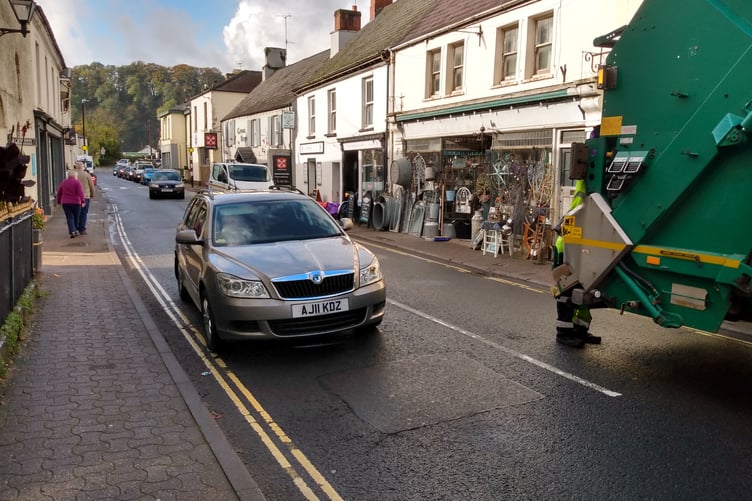
REFUSE chiefs are trying to rework collection routes for electric vehicles as a delay in switching from diesel trucks costing hundreds of thousands of pounds.
Welsh councils have been set a target of 2030 by when they should change from using diesel or petrol Heavy Goods Vehicles, including lorries for waste and recycling collections, to electric or Ultra Low Emission Vehicle equivalents such as electric powered trucks.
But that is posing problems for rural Monmouthshire as it cannot find ULEV equivalent vehicles suited to its steep hills or that are able to cover the large distances currently clocked up by crews in the county that stretches from the coast at Chepstow to the edges of the Bannau Brycheiniog National Park.
The county council’s latest financial report, covering spending throughout the 2025/26 financial year in which the authority recorded an overall surplus, shows £325,000 of a £411,000 overspend in its infrastructure directorate is due to pressures on its vehicle fleet, including hiring or leasing vehicles.
However at the same time delays in replacing vehicles has contributed to an underspend in its capital budget which covers one off investment costs.
When the report was discussed at the performance and overview scrutiny committee Councillor Paul Pavia called that a “paradox” and asked how the failure to replace vehicles could be “reconciled” with the overspend on hiring charges.
The Chepstow Mount Pleasant member said: “It looks like we are paying to maintain an aging fleet yet we’re sitting on capital money to invest in that fleet and not spending it.”
The Conservative also asked if the delay in buying new electric bin lorries was due to “competition” from other local authorities, across the UK, also trying to buy in the in demand trucks.
But chief infrastructure officer, Debrah Hill-Howells, said: “It’s not a capacity issue.
“The issue we are having with our vehicles at the moment is because of the nature of our topography and the range on electric refuse collection vehicles it does not enable us to run the service in the way we currently run them.”




She said the council is working with a firm to review routes to identify how it can switch to using ULEV equivalent lorries.
Ms Hill-Howells had confirmed the council is currently hiring or leasing replacement refuse collection vehicles when necessary rather than purchasing new vehicles “as we are aware of our obligations and guidance from the Welsh Government we should be looking at replacing our HGVs by 2030 with ULEV alternatives.”
She said the council is “yet to find” an alternative vehicle that works with its fleet and said: “We are incurring additional revenue costs while we try and wait for the vehicle types and availability to actually be able to mee the demands that we have for them.”
The Welsh Government target is for the public sector to achieve net zero status, in that it produces no more carbon emissions than it releases, by 2030 with a 2025 target for councils to replace light commercial vehicles and cars with ULEVs and 2028 for passenger transport vehicles such as buses.
ULEV replacements for other vehicles in the council’s fleet are more costly than what Ms Hill-Howells called “fossil fuel vehicles” and said: “The cost is at least double what we normally pay but we are transitioning our fleet.”
She also reminded the committee not all of the overspend is due to the delay in purchasing new bin lorries and gave examples such as new vehicles that are found to have faults, which have to be returned to the manufacturer, with the council incurring costs for hire vehicles to fill the gap.
Vehicles also have to be hired due to repairs and accidents but she said a fleet management board has been set up to monitor costs, driver behaviour and to consider what vehicles the council has and needs and if any can be released.
Part of the “slippage” in the capital budget, which is money carried over to future years, is also due to delays in establishing a new depot. Ms Hill-Howells said architects are currently working with the council but said it doesn’t want to be “too ahead” of when a potential site would be available.
Comments
We've recently changed our login process. If you have an account for commenting, you will need to re-register on the login window.
This article has no comments yet. Be the first to leave a comment.