

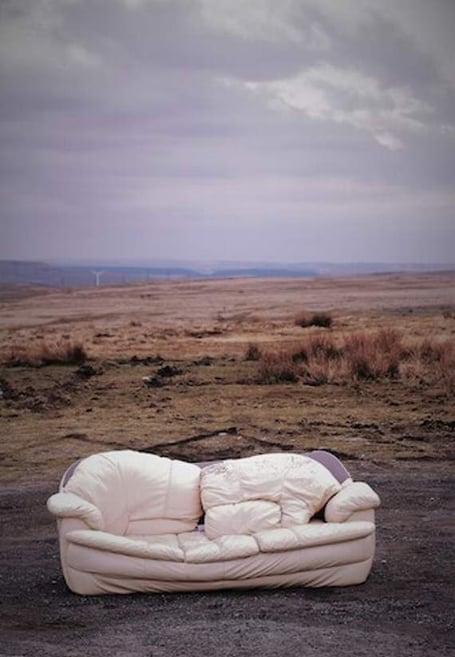
As Welsh Government statistics on fly tipping are published, CLA Cymru calls upon national and local government to demonstrate how they will make use of their powers and responsibilities to deliver much needed results, reports Hannah Jones.
“This is a crime in which innocent victims pay the penalties while perpetrators pocket some cash and go unpunished,” said Rebecca Williams, Director, CLA Cymru.
“Fly tipping is a national disgrace that contaminates land and watercourses, creates health and safety threats to humans and livestock, blights the countryside and leads to heavy clear-up costs by landowners, farmers and rural businesses. We’re calling on society to open its eyes to this issue and for effective action to be taken to tackle the problem.”
Wales’s fly-tipping figures show 35,434 formally recorded incidents on local authority land. Areas such as Powys and Carmarthenshire have seen dramatic increases in cases, (Carmarthenshire at 2,939 incidents, nearly 70% increase from last year; Powys up 50% from last year at 1,436 incidents). The cost of clearance of fly tipped waste from recorded incidents on local authority land alone is £1.9m.




“Last October we welcomed the Welsh Government’s new regulations which allow local authorities in Wales to issue fixed-penalty notices for fly-tipping incidents. Under the new provisions penalties could be imposed. However, government at all levels has to show commitment to meet their responsibilities. Failure to do so sends a message to the community that this crime is likely to pass by without a process of investigation and penalty.
“I fear that, as a community, we are so accustomed to this problem that we turn a blind-eye to this selfish, unsociable and irresponsible crime.”
Rebecca Williams continued, “Land managers who fail to clear-up waste deposited on their land face the prospect of prosecution for storing waste, apart from the penalties of damage and disruption. Some waste may require specially qualified operators and costly plant and equipment to clear.”
Annual incidence of fly-tipping remains at between 35,000-40,000, but cases on agricultural land and private businesses have returned back to the highest levels seen since fly-tipping was at its peak about ten years ago.
It appears that some fly-tippers may also have a keen eye on selecting sites to commit their crime. The average cost to private businesses of clearing fly-tipped waste is around £800 per case. If they do not clear this waste, they themselves can be prosecuted for the offence of storing waste.
“In Wales we value the quality of our landscape very highly,” Rebecca Williams, said.
“It is entirely appropriate that as strategies develop further for natural resources management, mechanisms are put into place to defend the quality of our environment.”
Results from a survey conducted by Farmers Weekly and CLA Insurance last year revealed that almost two thirds of farmers and landowners in England and Wales have been affected by fly-tipping and over half agree it is a significant issue in their area.
Most victims surveyed said that they had also been targeted on multiple occasions.
Comments
This article has no comments yet. Be the first to leave a comment.