
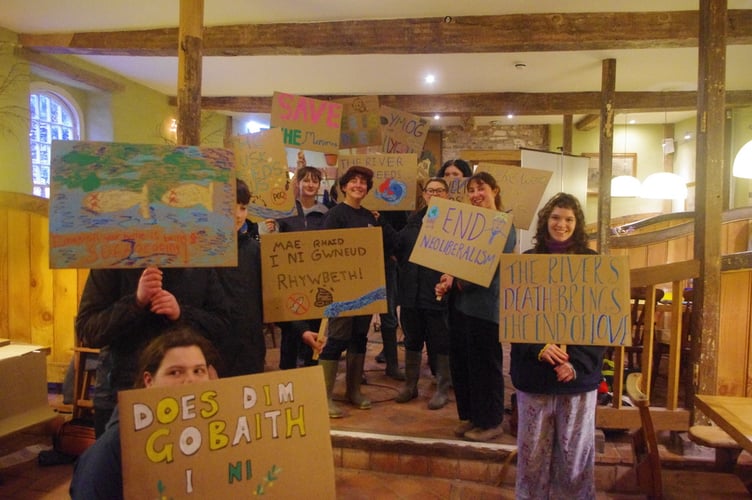
On a rainy day beside the river Usk, a group of young people sat down and did something radical: they wrote letters. Not to friends or family, but to the editor of this newspaper; they had something urgent to say about the state of their beloved Usk and they needed to be heard.
The workshop, led by Landed Futures, brought together young people from Peak Cymru and Action for Conservation, two organisations working to connect the next generation with the arts and the natural world. The result was a collection of honest, passionate, and sometimes heartbreaking responses to their feelings about the river and the life it sustains.
Jodie Bond, co-director of Landed Futures, said: "What came out of the workshop was extraordinary. They spoke with the kind of clarity that only comes from genuinely connecting with an issue and calling for change. The Usk means so much to them - it’s where they kayak, where they walk, where they've watched the fish disappear. When you give young people the space and the tools to express their feelings, the results are powerful."
For many of the young writers, the change in the Usk has been visceral and personal. Betsi, 15, has lived beside the river for a decade and describes watching it transform within her own memory.
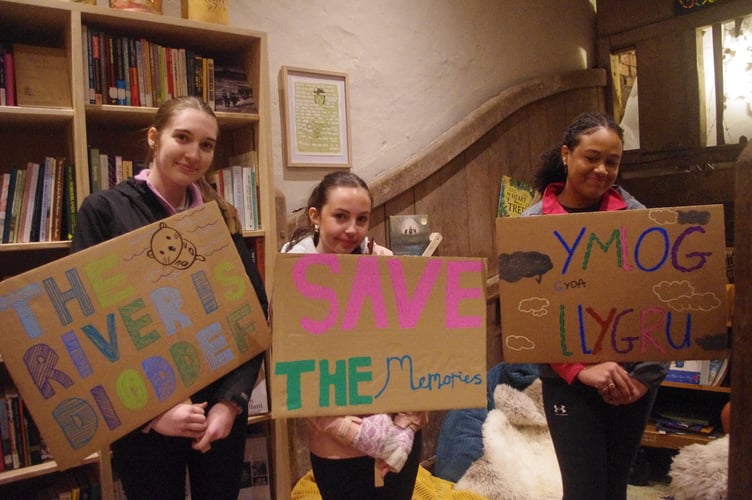
"A clear memory for me was watching the fish race around," she writes. "In recent years, there is no longer an abundance of fish or young children chasing them around, and the crisp waters which I spent my childhood summer days among are now clouded with algae."
Isla, 16, who has lived her whole life along the Usk, first in Newport, now in Crickhowell, echoes this sense of loss, but frames it as a call to action. "I believe the river should be enjoyed. I believe we should make the most of what we have, and I believe we need to save it," she writes.
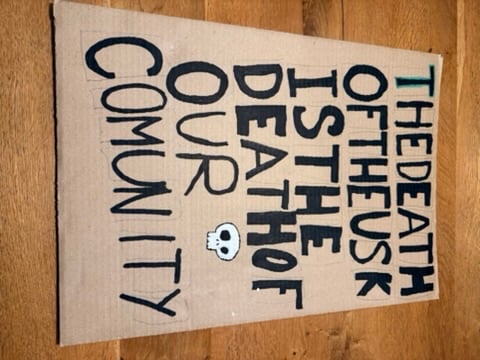
Isla has also noticed something telling: the people have gone, too. "Over recent years, I have noticed a dramatic decline in people around the river," she writes. "I myself used to go to the river all the time, whether that be swimming in summer or cold walks in winter. But this year I have seen barely anyone around. I think if we encourage more people to enjoy the river, more people will be aware of its suffering, and when more people are aware of its suffering, more people will step up to help."
While some wrote of grief and memory, others came with knowledge and anger. Ostyn Cobbett Evans wrote in Welsh about eutrophication: the process by which excess phosphorus enters a waterway, triggering algae blooms that starve the river of oxygen and devastate its wildlife. It is one of the Usk's most pressing ecological problems.
"The River Usk needs protecting," he writes. "Eutrophication is happening more and more; the river in my area, the Usk, is quickly filling with phosphorus. We are dealing with all the problems of losing our river. Welsh Government, do something before it is too late. If something doesn't happen quickly, there will be no river left."
Seren Lewis, 17, from Cwmbran, opened her letter with a personal memory. “The warm and gentle sun was on my skin as I strolled down the path. Then I stopped in horror. I saw a dead salmon floating on the Usk. I felt powerless watching it,” she writes. "Imagine your home is suffocating. Imagine your home being filled with sewage - then you will realise what it is like to be a salmon."
Mariama, 16, from Crickhowell, connects personal observation to collective action. "The once vibrant river that was bustling with life, surrounded by greenery, is now dull, lifeless, and clouded with pollution," she writes. "What we need is for people to come together and take action - for communities to remove invasive species and encourage new life."
Alice Snow, 23, is a Welsh learner from Brecon. "When I was a child, I thought the adults were working for the planet," she writes, going on to cite her cynicism and to demand more action.
Cosmic M, 17, describes a stream near their home that runs past a sewage plant, contaminated by waste, littered with plastic. But what makes their letter stand out is the hope and activism it inspires.
"I am sure I can't do much, at least not on my own. But I do know that if I play my part, and everyone else plays their part, then change is inevitable. Don't forget: we, as the 'ordinary people', are the majority. We have the power. We decide when and how to fix what's happening to the land, the rivers, the sea and the sky."
What unites all of these young voices is not just a concern for the Usk, but a deeply felt sense that they have inherited a problem they did not create and an insistence that this cannot continue.
They are involved in a three-year project, called Llifo/Flow, led by Action for Conservation, Landed Futures, Peak Cymru and the Usk Catchment Partnership Knowledge Hub. The project is establishing River Ranger Programmes for local young people and encourages decisionmakers to embrace community knowledge and youth leadership in the design, development and delivery of catchment-scale nature restoration efforts on Welsh rivers.
Find out more about the project’s previous work at bit.ly/3OnJXOB
Comments
This article has no comments yet. Be the first to leave a comment.