
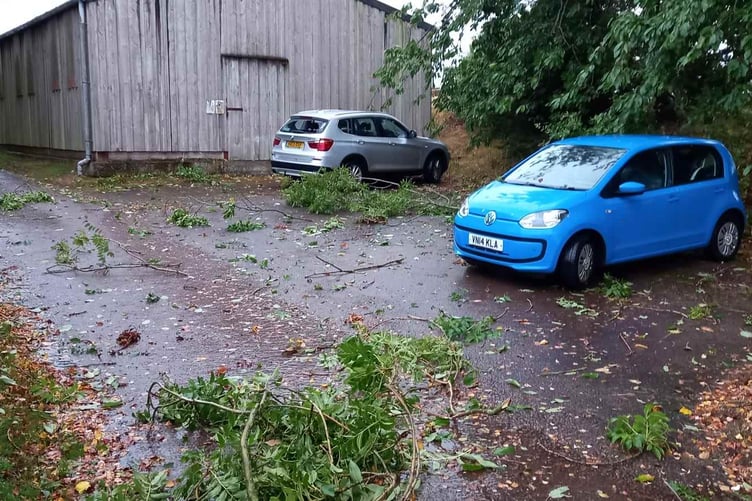
A tornado swept close to the village of Llanishen Sunday evening (August 30) leaving a trail of destruction in its wake and a blackout.
Trevor Neale and his wife Alison were sat in their living room around 8pm and heard an almighty bang outside.
“The car alarm went off so we went outside to see branches strewn all over the yard and the back window to my car smashed,” he said.
Alison spotted the pole-mounted electricity transformer was sparking and caught fire.
It was estimated around 600 homes lost their power, including Trevor’s, but his soon returned.
“My neighbour Gwilym Richards bore the brunt of the tornado as his garden was covered in branches and his plum tree had been uprooted and thrown 30 metres into the neighbouring garden.
“The roller shutters on his garage were also bent.”
It was reported that gazebos at Llanishen Village Hall had also been blown away.
“If it had been centred over the house, I am sure my roof would have been ripped off;” Trevor added. “As it was, the loft access inside the house had been sucked up into the roof space.”
Trevor said that the whole episode only took about 30 seconds to pass through, “I was shocked the way the trees were bent and ripped,” he added.

.jpg?width=209&height=140&crop=209:145,smart&quality=75)
Despite its relatively calm reputation, the UK sees around 30 tornadoes reported each year. England, in particular, has one of the highest tornado densities in the world.
While UK tornadoes are typically small and short-lived, they are more common than many people realise. Most have estimated wind speeds of up to 72 mph, placing them in the T0 or T1 categories on the TORRO scale, a UK-developed system that classifies tornadoes based on wind speed.
Comments
We've recently changed our login process. If you have an account for commenting, you will need to re-register on the login window.
This article has no comments yet. Be the first to leave a comment.