
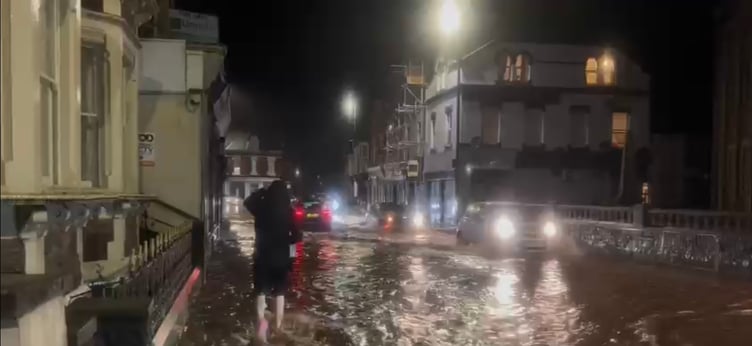
A PLAN to address the risk of flooding has been approved after the worst storm in a generation hit last November.
But there was a warning the Welsh Government will have to put more money towards flood prevention to avoid a repeat of the devastation caused to Monmouth last year.
Storm Claudia caused widespread flooding and disruption across parts of Wales and England in November 2025 including north Monmouthshire with Monmouth’s Monnow Street and surrounding areas left underwater – forcing people from their homes and closing some businesses for months.
Monmouthshire County Council’s cabinet has approved its local flood risk strategy which replaces the previous flood strategy and flood risk management plan.
Councillor Catrin Maby, the Labour cabinet member for the environment, said the new plan was drafted last year and reviewed following November’s flooding with the public also consulted.
The plan divides the county into nine areas, based on river catchments, which Cllr Maby said is a strategic approach as the council is responsible for the risk from surface water, groundwater and what are called “ordinary watercourses” such as smaller rivers. It has joint responsibility for coastal flooding.
Environmental body Natural Resources Wales has responsibility for main rivers and the plan is intended to help authorities work together.
Cllr Maby said: “It is taking a more strategic approach and not ignoring the risk that rests with other authorities.”
The six year plan also addresses flood prevention such as how land management can be used to hold water.
Input from residents has helped the council identify vulnerable areas and how localised flooding interacts with the risk from main rivers.
 Everything you need to know before arriving at the Abergavenny Food Festival
 Woman who fled Ukraine at 97 celebrates her 100th birthday with family
 Council says it will continue to learn lessons from Blaenavon wildfire response
 Pub owners who build a programme for their community win top national award
Deputy leader Paul Griffiths said before he was elected to the council, in 2022, he had for a short period chaired Natural Resources Wales’ flood committee and said it was, and remains, underfunded with only around £30 million a year to spend on flood alleviation schemes across Wales.
He said that would only fund one or two projects a year, across the country, and they could take up to 10 years from design to being put in place.
The council should press the Welsh Government and Natural Resources Wales for more funding to their schemes during upcoming meetings, said Cllr Griffiths.
He also said more funding should be put towards flood prevention, including in the hills of Mid Wales and the Black Mountains, rather than simply trying to overflowing water.
“That will require significant investment and some radical redeployment of budgets related to farm payments,” said Cllr Griffiths.
Council leader Mary Ann Brocklesby said the plan could be a “reference document for everybody who has a concern and interest in the state of our rivers and how we manage flooding locally.”
The cabinet agreed to submit the plan to the Welsh Government for approval before it can be officially adopted by the council.
Comments
This article has no comments yet. Be the first to leave a comment.