
CAMPAIGNERS opposed to the construction of a 67-acre solar farm at Llanvapley were jubilant on Tuesday as they persuaded Monmouthshire planners to reject the proposal.
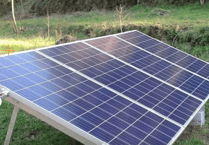
The application, submitted by Camborne Energy Investments Limited, would have seen the installation of some 42,000 solar panels on agricultural land at Manor Farm and Crossways Farm, between Llanvapley and Llanvetherine - a scheme that was expected to generate 10 megawatts of electricity.
In light of the proposals residents formed Beautiful Yet Threatened (BYTH) - a pressure group opposed to the new use of the seven irregular shaped fields.
At Monmouthshire County Council's planning meeting held on Tuesday, BYTH spokesman Les Taylor created an historic first for the county by becoming the first person to address the authority in Welsh - a move which called for a translator to be brought in and listening devices to be given to each member of the planning committee at County Hall.

Addressing the committee Mr Taylor said, "It is impossible to estimate the financial cost to the community as a result of these massive changes to the landscape and to the area.
"It is not fair that the company is gaining so much, some £2million a year from the sale of energy to the national grid, while at the same time the community will lose out.
"There was no opportunity for the community to discuss the plan during pre-application. Camborne Energy decided to offer nothing."
County Councillor Sara Jones told the committee, "I strongly support agricultural diversification, however having listened to the representations made by local residents, I believe this scheme will have a visual impact on Monmouthshire.
"I feel it could affect tourism as it is more than twice the size of the schemes at Kemeys Commander and at Llancayo.
"I fully support the intentions of the landowners and they must be applauded for considering a green energy option, but it's the scale of the development that worries me and I feel it should be reduced in size."
County Councillor David Jones said that it was generally agreed that the seven fields were good quality agricultural land.
"If we allow this scheme to go ahead, it will mean that this valuable land will be taken away from food production for at least 25 years,"?said Councillor Jones
Community councillor Robert Walker stressed that this was not a case of nimbyism as most people accepted the principle of solar farms.
"This area is full of traditional farming families working some of the best agricultural land in the county.
"Could the developer not look at making use of brown field sites instead or other former industrial or ministry of defence land that is not in full view of the mediaeval Whitecastle?"
Another community councillor Chris Lewis said local people's main concerns related to the overall scale of the development.
"This application is industrialisation of the countryside. There is no benefit to the local community and who would want to live in an area with a blot on the landscape?"
"I fully support green energy proposals, but this scheme is just too big and I suggest that it is significantly reduced in scale,"?said Councillor Lewis.
Robin Foord, farmer and one of the landowners of the proposed solar farm site, told the planning committee that the land would still be used for grazing of sheep.
He explained that the poor financial return over the past few summers had forced the family to look for an alternative solution to bring in an income and he felt that green energy was the way forward.
Jonathan Townend, managing director of Camborne Energy Investments told the committee that the proposal would help sustain a farming income for the two landowners.
He also pointed out that there were only a few places in the county where the solar farm could be connected to the high voltage electricity supply network.
"We propose to link up to the 66kv line between Monmouth and Abergavenny which means that the electricity generated will flow directly into the local electricity network supplying about 20 percent of the power needed by local businesses, homes, offices, schools and hospitals.
"We were asked at the public exhibition if we were proposing to provide a more direct benefit to the local community and we indicated our willingness to do so, an offer which still stands."
Councillor Roger Harris, a former scientist, said:, "For more than 200 years man has plundered the landscape for coal and gas - fossil fuels that when burnt create carbon dioxide.
"Sunlight is free and in converting it to electricity it doesn't create carbon dioxide emissions. We have an obligation to future generations to do the right thing."
Councillor David Dovey said, "My main concern is if we approve this scheme it could give us a problem in the future if other farmers choose to take the same line and use their land as a solar farm, which in turn would take more land away from agriculture."
After a 75 minute debate, members rejected the application by eight votes to six saying that the landscaping and scale of the development was too large.
Councillor Ruth Edwards, chairman of the planning committee told the packed public gallery that the application would come before members again next month for ratification as the vote had gone against the officer's recommendation.
Comments
This article has no comments yet. Be the first to leave a comment.